
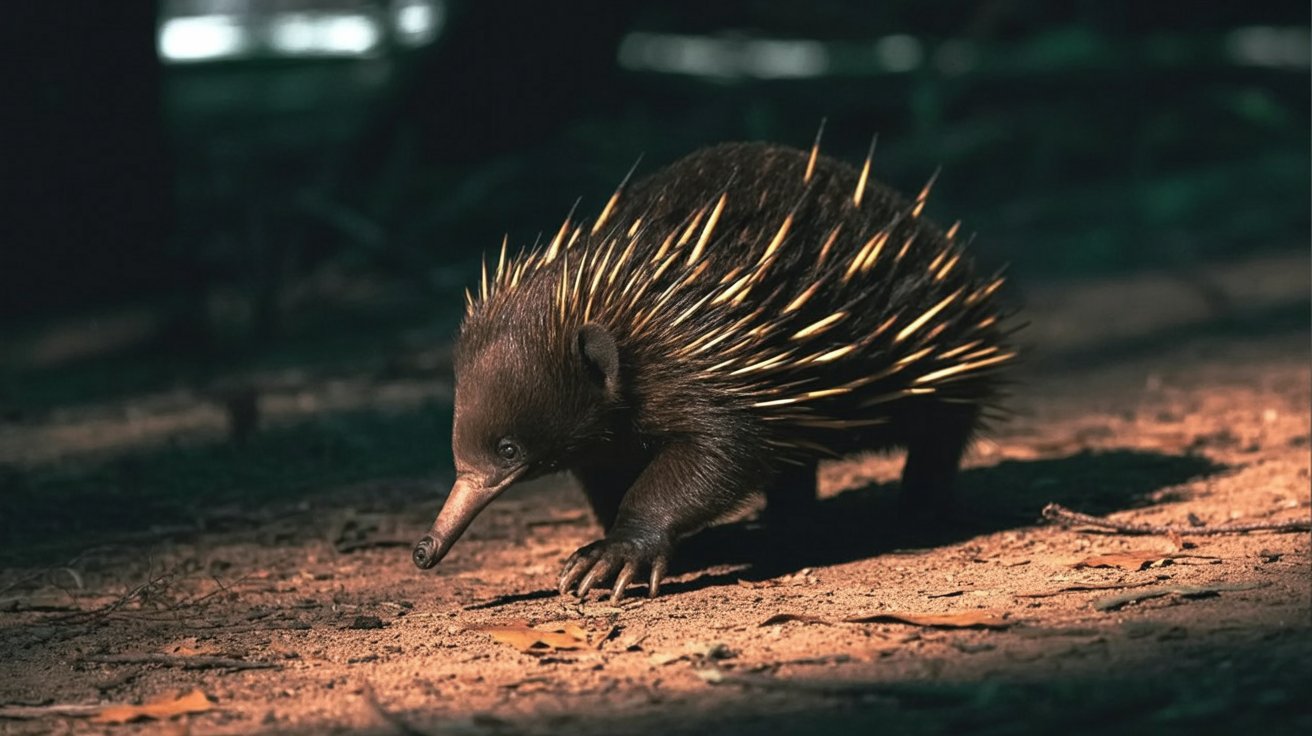
The short-beaked echidna penis has four rosette-like heads, but only two appear to function at once during mating, acting less like four separate tips and more like a quadrifurcate sperm-delivery organ built to channel semen in bundled streams, according to anatomical work on Tachyglossus aculeatus and earlier reproductive studies on echidnas (PubMed anatomy paper; PMC reproduction paper).
That matters because the odd-looking structure is not just decorative anatomy. Researchers found a quadrifurcate urethra ending in four separate glans rosettes, while behavioral and reproductive observations suggest only two glans become enlarged during copulation and ejaculation, with the other two inactive, and males ejaculate sperm in bundles.
How the echidna penis works
According to the 2021 anatomical study in Sexual Development, the adult short-beaked echidna penis sits fully retracted inside the preputial sac when not in use. It is not visible externally in the relaxed state, which already tells you this is specialized machinery, not a standard mammalian setup with a simple exposed shaft.
The same anatomy paper describes the organ as having a quadrifurcate distal end with four separate rosette-like glans heads. Each head is supplied by erectile tissue and connected to one branch of the split urethra. In plain terms, the tube carrying semen divides near the end, then divides again, so the penis terminates in four outlets rather than one. It looks less like a conventional mammal penis and more like a tool built to place sperm very precisely.
Earlier reproductive work by Peggy Rismiller and colleagues described the echidna penis as “quadripartite” and “anemone-like”. That paper also reported the key functional detail: during erection, only two of the four terminal glans are engorged at a time. The other two do not appear to participate in that mating bout.
That means the answer to “do all four heads work at once?” is no. The best available evidence says two heads are active at a time, not all four simultaneously (PMC reproduction paper).
Why it has four heads
The short answer is that researchers do not yet have a final, experimentally proven answer for why evolution settled on this design. But the evidence points to sperm competition and delivery mechanics, not spectacle.
The older reproductive paper found that echidnas ejaculate sperm in bundles of up to about 100 sperm cells. That is unusual for mammals. The authors suggested the penis may function as part of a system adapted to delivering those sperm bundles efficiently into the female reproductive tract (PMC reproduction paper).
The anatomy study adds the hardware explanation. With a four-way terminal structure and extensive erectile tissues in the distal penis, the echidna appears to have evolved a penis specialized for controlled distal expansion and directed semen flow. Not four simultaneous shafts. More like a branching nozzle with selectable outlets.
There is also a likely competition angle. Echidnas are one of the few mammals for which courtship trains of multiple males following one female have been documented. When several males are lining up for the same mating opportunity, reproductive anatomy gets weird fast. Biology does not always produce elegant solutions. Sometimes it produces something that looks like it was designed by committee and works anyway.
One useful derived number here: if the animal has four glans but only two become functional in one erection, then about half of the terminal heads are active in a given mating event. That is the simplest way to think about it: four-part anatomy, two-part deployment.
What researchers have found so far
The clearest modern description comes from the 2021 dissection-based morphology paper, which mapped the penis structure in detail and confirmed the four rosette glans and split urethral pathway. That paper framed the echidna penis as highly distinctive even among monotremes, the egg-laying mammal group that includes platypuses and echidnas.
The broader reproductive context comes from the 2009 Frontiers in Zoology paper, which linked penis form to mating behavior, sperm bundling, and the overlap between hibernation and breeding. That is where the two-heads-at-once observation comes from, and it remains the key functional finding for how the organ actually operates during mating.
A more recent paper on female short-beaked echidna reproductive anatomy mainly focused on females, but it also notes that the adult male penis is fully internal when retracted, which fits the picture from the male anatomy work.
What is still missing is direct live imaging of copulation showing exactly how the active pair is selected, whether the active pair alternates between matings, and how the penis interfaces mechanically with the female tract. So, the broad answer is settled. The fine-grained choreography is not.
Key Takeaways
- The short-beaked echidna penis has four rosette-like heads and a quadrifurcate urethra.
- Only two of the four heads appear to become erect and functional during a mating bout.
- Echidnas ejaculate sperm in bundles of up to about 100 sperm, which may help explain the unusual delivery system.
- The organ is fully retracted inside the body when not in use.
- Researchers think the anatomy likely relates to sperm competition and delivery mechanics, but that evolutionary explanation is still an inference rather than a fully proven mechanism.
Further Reading
- The Unique Penile Morphology of the Short-Beaked Echidna, Tachyglossus aculeatus, Primary anatomy paper describing the four rosette glans and quadrifurcate urethra.
- Cool Sex? Hibernation and Reproduction Overlap in the Echidna, Reproductive study discussing mating behavior, sperm bundling, and the two-active-heads observation.
- Observations on the reproductive morphology of the female short-beaked echidna, Tachyglossus aculeatus, Female anatomy paper that also notes the male penis is retracted internally at rest.
References
- Grutzner et al., 2021, The Unique Penile Morphology of the Short-Beaked Echidna, Tachyglossus aculeatus
- Rismiller et al., 2009, Cool Sex? Hibernation and Reproduction Overlap in the Echidna
- Schultz et al., 2024, Observations on the reproductive morphology of the female short-beaked echidna, Tachyglossus aculeatus
Last reviewed: 2026-06