
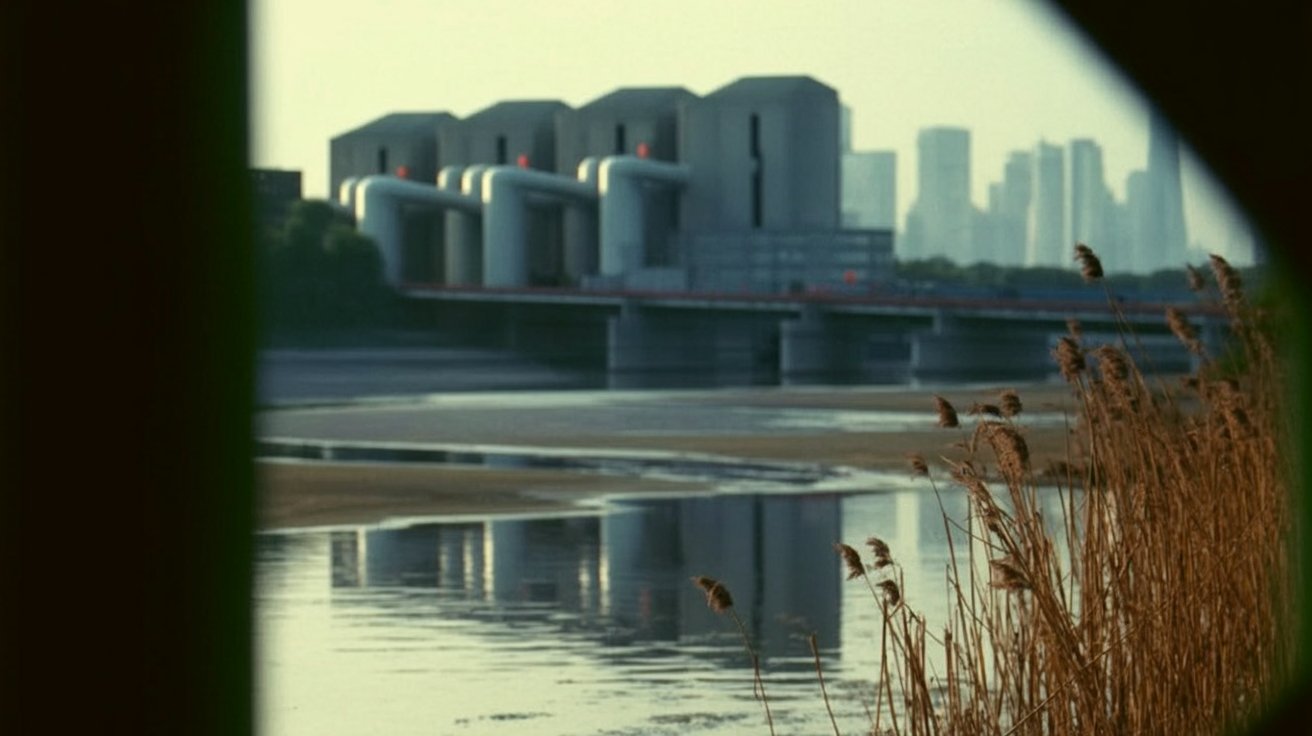
Thames Water’s Beckton desalination plant was unavailable as London entered drought conditions in July 2026, leaving the capital without the emergency water source built for severe dry spells. The company had said in September 2025 that reservoir-safety work, essential maintenance and approval for replacement membranes were keeping the plant out of service, as reported by the Guardian.
The failure was not likely to have been the single cause of restrictions: even at full output, Beckton was designed to provide only up to 5% of London’s supply in very dry conditions. But its absence removed a resilience asset precisely when southern England received just 1% of its expected July rainfall.
Beckton’s 150-ML-a-Day Design Capacity Has Never Been Reliable
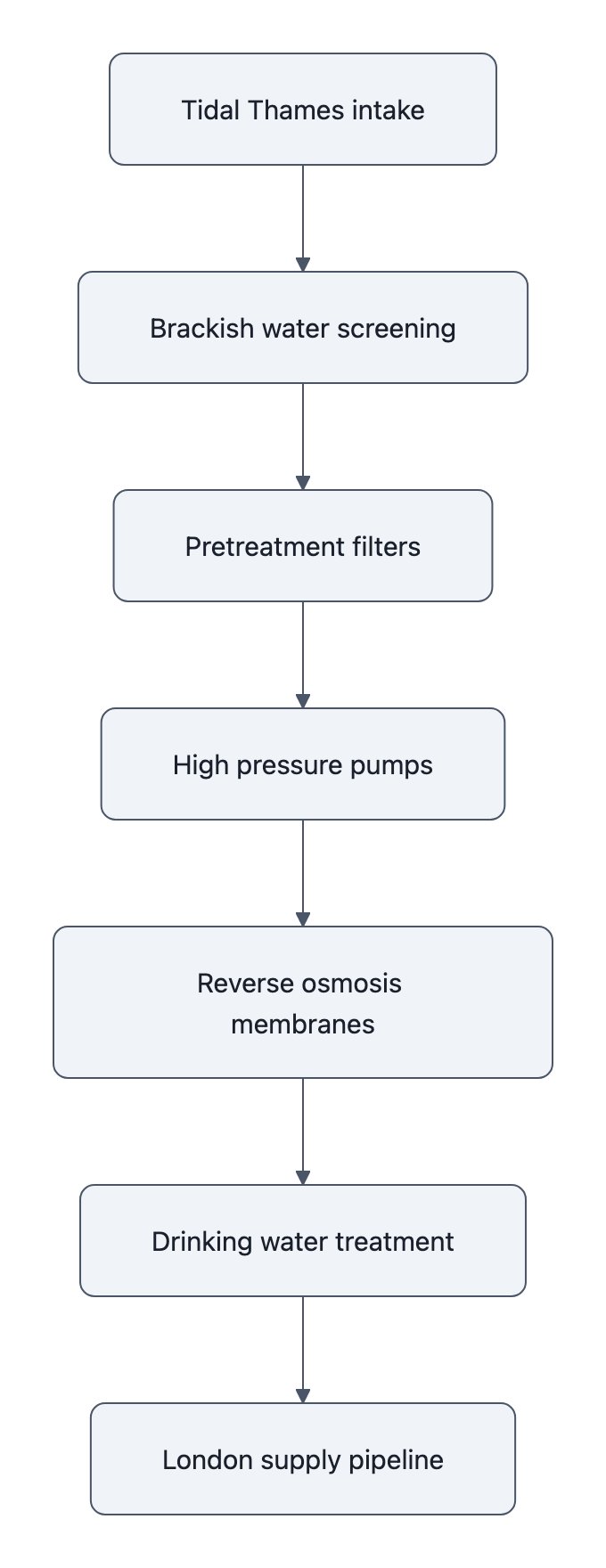
The Thames Gateway Water Treatment Works at Beckton is mainland England’s only existing desalination scheme for public water supply. It takes brackish water from the tidal Thames and uses reverse osmosis, high pressure forcing water through membranes that block salt and contaminants, to make drinking water.
It is not Britain’s only desalination plant. The Isles of Scilly system supplies roughly 40% of the islands’ water needs, but Beckton is the unusual mainland installation intended to support a large public network during drought.
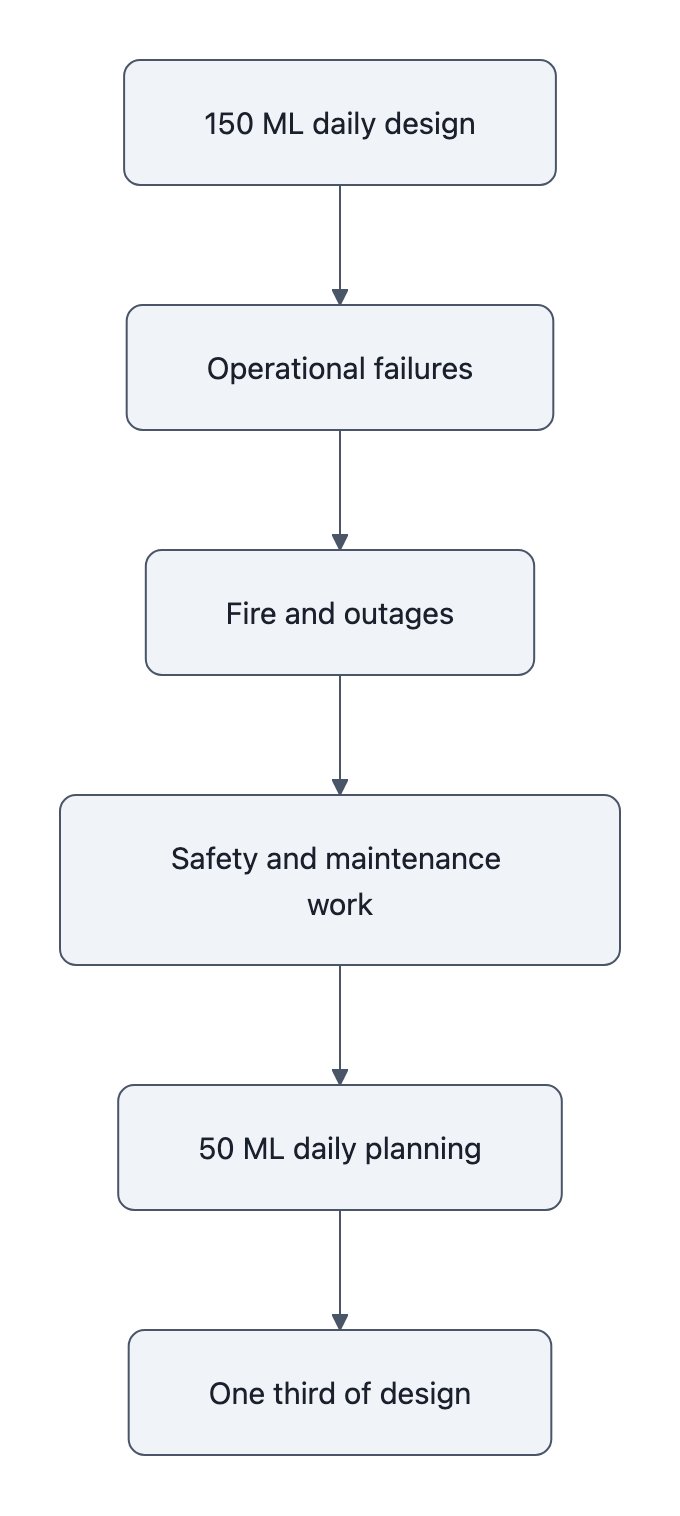
The Environment Agency lists Beckton’s design capacity at 150 million litres a day. That figure is a design maximum, not a reliable drought contribution. Thames Water reduced its planning assumption to 50 million litres a day after the 2022 drought, following failures that exposed the gap between what the plant could theoretically make and what it could safely deliver.
The company’s own drought review records an electrical fire, a planned outage, and health-and-safety upgrades. A July 2023 test reached 25 million litres a day, and Thames Water said it aimed to plan for 75 million litres daily during drought by 2030.
That makes the contrast blunt. Beckton was built around a 150-million-litre daily headline capacity, but Thames Water’s nearer-term planning figure was one-third of that.
The 2026 drought made that distinction tangible. On 29 July, Defra and the Environment Agency declared drought across London and six other English areas. Thames Water had already moved London and its wider operating area to drought level 1 earlier that month.
The reason for the plant’s unavailability remains chiefly Thames Water’s account. Its stated restart timetable for 2026 is a company commitment, not independently verified evidence that the work and regulatory approval have been completed.
The Plant Delivered 7.2 Billion Litres in 15 Years
Beckton opened in 2010, but it has operated in only five periods and produced 7.2 billion litres through 2025, using Thames Water data reported by the Guardian. At the original 150-million-litre design rate, that lifetime output equals about 48 days of full-capacity production, 7.2 billion divided by 150 million litres a day.
The same reporting put its combined capital, debt interest, maintenance and operating costs at £518 million. That is a large price for an emergency asset, but emergency assets are not judged only by annual throughput. They are judged by whether they work on the day the emergency arrives. Beckton’s record is poor on that simpler test.
Would a functioning Beckton have prevented London drought restrictions? No. At its stated maximum, it was only ever meant to cover a small slice of demand, not replace reservoir management, leakage reduction, demand controls or additional water sources. The Environment Agency’s position statement treats desalination as one option among several, while noting operational challenges at Beckton since 2018.
Still, 50 million litres a day is not nothing during a drought. It is water that could have reduced the pressure on the rest of the network while London waited for rain, conservation measures and other supply projects to do their slower work. The more accurate verdict is not that Beckton could have solved the 2026 shortage; it is that London’s designated backup was unavailable when backup was the point.
Key Takeaways
- Beckton was unavailable as London entered drought conditions in July 2026.
- Thames Water cited safety work, maintenance and replacement-membrane approval as reasons for the outage.
- Beckton’s 150-million-litre daily design capacity was reduced to a 50-million-litre daily planning assumption after the 2022 drought.
- The plant delivered 7.2 billion litres across five operating periods between 2010 and 2025.
- Even at maximum output, Beckton was intended as a drought-resilience asset rather than a full solution to London’s water shortage.
Further Reading
- Drought declared in half of England, Defra and Environment Agency announcement on the July 2026 drought declaration.
- Desalination for public water supply: Environment Agency position statement, The regulator’s account of Beckton’s role and design capacity.
- Thames Water: Lessons from the 2022 drought, Thames Water’s review of operational problems and revised planning output.
- £500m Thames Water desalination plant has provided just seven days’ water over 15 years, Independent reporting on the plant’s costs, output and availability.
- Dry weather and drought in England: 10 July to 16 July 2026, The Environment Agency’s weekly drought report covering Thames Water’s status.