
Microsoft’s own internal material says its AI-answer strategy can create a “doom loop”: publisher work feeds the models, the models answer readers without sending them back, and the lost traffic weakens the businesses that pay for more work. A partly unsealed September 17, 2026 filing in The New York Times copyright case says Copilot’s click-through rates were 83%-93% lower for Times and Daily News sites than those from traditional Bing Search.
The mechanism is not mysterious: a reader asks a question they once would have searched, receives a synthesized answer in Copilot or ChatGPT, and never visits the reporting or guide that supplied the answer’s material. The filing is the publishers’ argument, not a court ruling, but it puts Microsoft’s own measurements beside executives’ testimony that AI products are replacing publisher visits.
Microsoft’s 83%-93% Click-Through Drop
The newly public brief, filed by The Times, the Daily News, and other news plaintiffs against Microsoft and OpenAI, cites internal documents, depositions, and product data that the companies had sought to keep sealed or redacted. Its central claim is that generative-AI products do not merely summarize the web; they can turn the web into upstream inventory.
Microsoft’s reported data compares Copilot’s answer engine with ordinary Bing Search on specific publisher domains. For The New York Times, the filing says Copilot generated click-through declines of 87%-93%; for Daily News papers, the range was 83%-91%. Ziff Davis sites saw declines ranging from 51% to 94%.
| Publisher domains | Copilot click-through decline versus Bing Search |
|---|---|
| The New York Times | 87%-93% |
| Daily News papers | 83%-91% |
| Ziff Davis | 51%-94% |
These are not measurements of every publisher or every AI product. They are, however, unusually direct evidence from the company operating the answer engine: when the interface answers instead of linking, fewer people click through.
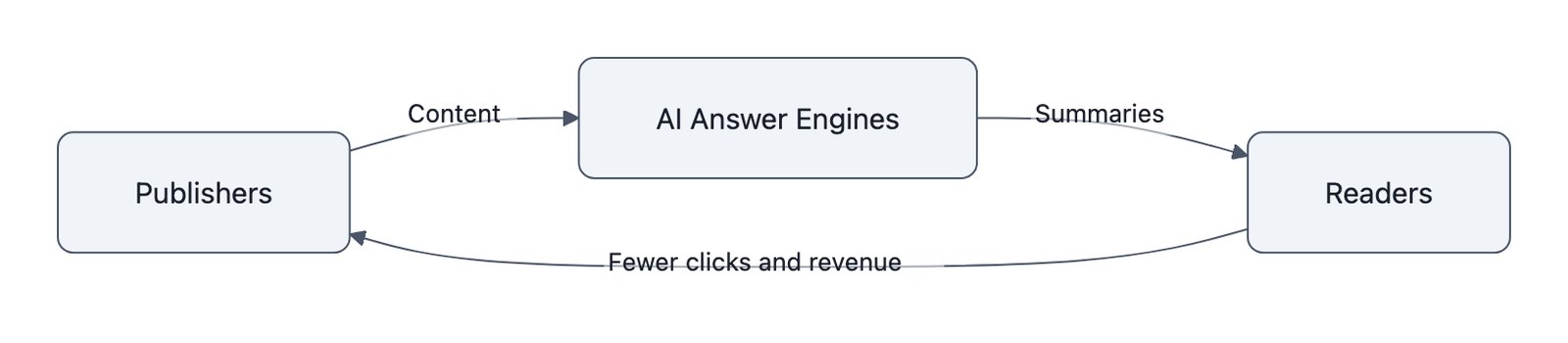
The brief attributes the “doom loop” phrase to Microsoft strategy material warning that its AI content approach endangered “the entire web.” It also says Microsoft chief executive Satya Nadella testified that chatbot conversations had substituted for publisher sites.
“Our AI content strategy has started a ‘doom loop’ …”
The quoted language appears in the news plaintiffs’ summary-judgment brief, which cites Microsoft internal material. Microsoft told Bloomberg Law that remarks attributed to Brent Hecht, a director of applied science, reflected one employee’s perspective rather than Microsoft’s corporate view or legal analysis.
OpenAI’s Nick Turley, head of ChatGPT, was similarly quoted in the filing as describing AI products as “largely substitutive” for publishers and likely to become more so as they improve. That is the important admission in the record: a better answer engine is not necessarily a better referral engine. It can be a more complete replacement for the page the reader would otherwise have opened.

This is the same AI content feedback loop threatening the web’s source material: reporting, reviews, how-to pages, and other creator work furnish the useful material; answers built from that material keep users in the AI product; the sites supplying the material lose the visits that support their next article.
The Publisher-Revenue Record Behind the Filing
The referral problem is larger than this lawsuit and larger than Microsoft. Similarweb data reported in July 2025 found that news-related Google searches ending with no click rose from 56% when AI Overviews launched in May 2024 to nearly 69% by May 2025. ChatGPT referrals were rising quickly, but Similarweb found they did not compensate for the lost search traffic.
That distinction matters. A referral surge from a small base can look spectacular while failing to replace traffic from the dominant search channel. AI companies can point to outgoing links; publishers need enough readers arriving to sell subscriptions, advertising, and the commercial services that fund reporting.
A better answer engine is not necessarily a better referral engine.
The financial picture at The Times is not one of immediate collapse. The company reported Q2 2026 revenue of $762.5 million, up 11.2% year over year, while digital-only subscription revenue rose 16.4% and total subscribers reached 13.35 million. Those results show a publisher with a substantial direct-reader business, not one dependent on a single stream of search clicks.
But the same filing records a less forgiving part of the business. Print advertising revenue fell 11.1% to $35.2 million in the quarter, and print subscription revenue declined 0.8% to $130.0 million. The company also spent $4.6 million on pre-tax generative-AI litigation costs, up 32.6% from a year earlier.
The wider pressure is not occurring in isolation from Microsoft’s wider AI economics and budget pressure. Answer engines are expensive to run, and their commercial logic favors keeping a user inside the product long enough to make that cost worth paying. Sending the user away is useful when it improves trust or fulfills a search promise; it is less useful when the product is sold as the destination.
Microsoft argues that training AI on copyrighted material is fair use and that Copilot does not substitute for publishers’ journalism. OpenAI’s September 4 summary-judgment motion cited experts who concluded that ChatGPT had not negatively affected the plaintiffs’ web traffic, according to OpenAI’s account of the litigation. Some underlying material remains sealed or redacted.
Those are issues for the court. The unsealed record establishes something narrower and more practical: Microsoft measured dramatically lower outbound clicks from its answer engine than from its conventional search results, while its own documents contemplated the revenue consequences for the sites supplying the underlying work. The companies may yet win their fair-use arguments. That would not make the traffic arithmetic disappear.
Key Takeaways
- The September 17, 2026 filing made public internal Microsoft and OpenAI material cited by news publishers in their copyright case.
- The filing says Copilot click-through rates were 87%-93% lower for The New York Times than traditional Bing Search.
- Daily News domains saw reported Copilot click-through declines of 83%-91%.
- Similarweb reported that nearly 69% of news-related Google searches ended without a click by May 2025.
- Microsoft and OpenAI dispute that the record proves copyright liability or net harm to publishers’ traffic.
Further Reading
- News Plaintiffs’ Combined Summary Judgment Brief, The partly unsealed filing citing internal documents, testimony, and Copilot click-through data.
- OpenAI, Microsoft Leaders Admitted AI Threatens News, Books (2), Independent reporting on the newly public filing and the companies’ responses.
- Reporting the facts about the New York Times’ lawsuit, OpenAI’s account of its legal position and fair-use defense.
- nyt-20260630, The New York Times Company’s Q2 2026 Form 10-Q.
- ChatGPT referrals to news sites are growing, but not enough to offset search declines, Similarweb estimates on zero-click searches and AI referrals.