
Between 16 and 25 November, attackers reached customers through four suppliers those customers trusted. Malicious code served by Optimizely ran on the websites of 178 organisations, including the BBC, HSBC and Equifax. Microsoft’s own agent-framework Python package, which gets about 41,000 downloads a week, shipped a credential stealer. 1Password’s backend was made to copy customer records. Commits were rewritten in at least 7,609 GitHub repositories.
Only one of the four, Optimizely, has said how the attacker got in. Its flaw now has a public tracking number, CVE-2026-132224, and CISA, the US government’s cybersecurity agency, added it on 24 November to its list of flaws known to be exploited. Microsoft and 1Password have described what happened. Microsoft says two releases “were uploaded to PyPI without authorization“, PyPI being Python’s public package registry. The security firm Wiz says the attacker appears to have held a certificate and private key for Microsoft’s internal release-signing service. 1Password names a hijacked employee GitHub account and says the rest is coming “in the coming weeks”. GitHub has said nothing, although the security firm Apiiro warned it on 15 October and offered the full list of infected repositories.
| Supplier | What it says about how the attacker got in | What researchers have found |
|---|---|---|
| Optimizely (16 Nov) | A flaw in its account signup flow, CVE-2026-132224 | Code was live at 04:21 UTC, 3.5 hours before Optimizely’s timeline begins |
| Microsoft (17 Nov) | “Uploaded to PyPI without authorization” | A stolen certificate and key for ESRP, its internal signing service (Wiz) |
| 1Password (19 to 25 Nov) | An employee’s GitHub account; how it was taken comes later | Nothing beyond the account |
| GitHub (PolinRider) | No public statement | Tokens stolen from developers’ infected machines, used to rewrite history |
Optimizely: a named flaw, and a clock that starts late
Optimizely sells website A/B testing. A customer loads one Optimizely script on every page, a per-customer file researchers call a snippet, and whatever the customer has saved in its “Project JavaScript” field runs inside it. Optimizely’s initial report to customers says the attacker:
exploited a vulnerability in the Optimizely Web Experimentation account signup flow
According to the report, the flaw let them “act as administrator users without those users’ credentials,” and the breach was “not the result of a compromised Optimizely administrator account,” so the attacker did not need to steal anything to get in. The Cloud Security Alliance (CSA), an industry research body, notes that Optimizely has not explained how a signup flaw reached unrelated customers’ projects.
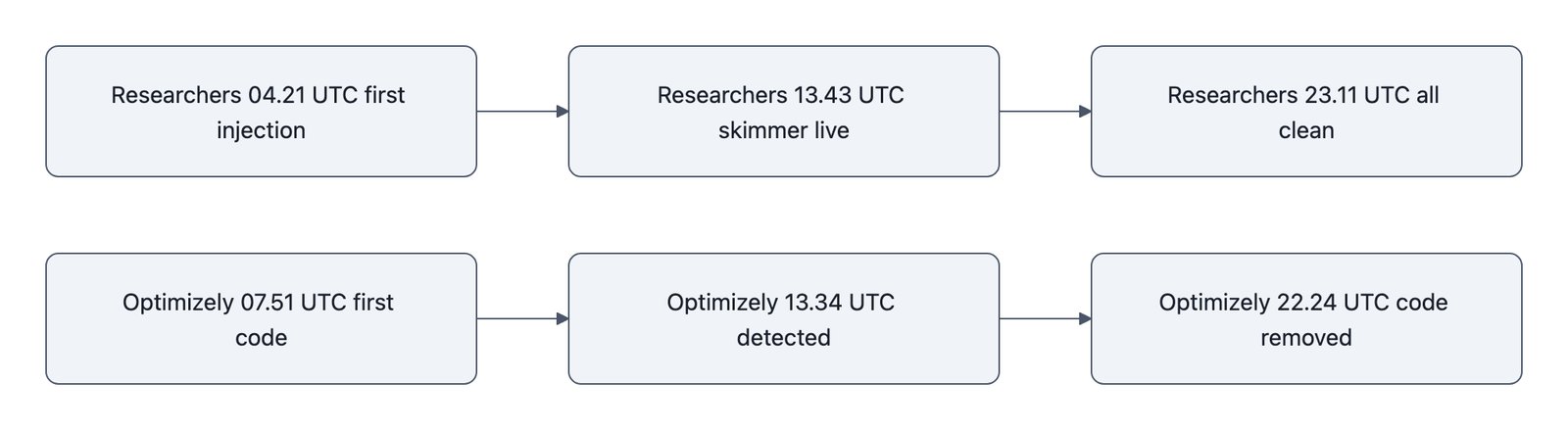
The same report gives Optimizely’s timeline:
- 07:51 UTC: first malicious code
- 13:34: detection
- 16:10: flaw closed
- 22:24: code removed
Researchers saw the attack earlier. Deepwatch, a threat-research firm, logged the first injection at 04:21 in a BBC snippet, and CSA’s minute-by-minute timeline agrees. CSA says that early code used a different loader, a small program that fetches the real malware, from what it calls “an earlier wave.” That may explain why Optimizely’s clock starts later, but the code still arrived through Optimizely.
Both research timelines put the card skimmer at 13:43, nine minutes after Optimizely says it detected the attack. Report URI, a service that monitors the scripts running on websites, found every snippet clean only at 23:11. A customer checking its logs should search from 04:21 to 23:11, not the 07:51 to 22:24 window Optimizely gave.
Optimizely’s advisory says it “closed the vulnerability within three hours of detection” and that “less than 5% of our customers were impacted.” Optimizely publishes no customer total, so nobody can check that 5%. In Report URI’s sample, 186 of the 1,611 snippets it checked were infected, about 11.5%.
Deepwatch names the BBC, CNN, Fox News, Zoom, HSBC, Equifax, Salesforce and GitLab among the victims. Report URI’s list, reported by The Paypers, adds Ledger, OANDA’s Coinpass, IG, Interactive Investor, TMS Brokers and IKEA. The code did several things:
- swapped crypto wallet addresses for the attacker’s
- read card numbers typed into sites’ own forms, though not fields inside Stripe or Adyen payment frames
- took cookies and screenshots
- sent iPhone and iPad visitors to the Coruna and DarkSword exploit kits, which are code built to attack the phone itself, according to Report URI CEO Scott Helme
The confirmed losses are smaller than that list suggests. Helme said there was no evidence card details were actually captured. Attacker wallets received about $7,100, or $6,600 by StepSecurity’s count, and Alex Thorn of Galaxy Digital estimated that victims sent around $2,300. Ledger said its devices were unaffected, and OANDA said Coinpass’s exposure was limited to marketing and blog pages. Optimizely has published no card count.
Microsoft: “uploaded without authorization”, and nothing about the key
agent-framework is Microsoft’s official Python package for building AI agents. On 17 November, version 1.26.1 appeared on PyPI at 20:35:20 UTC, and PyPI pulled it from download at 21:06:16. Version 1.26.2 went up 2 minutes 23 seconds later and lasted until 21:16:44, for about 39 minutes of exposure across the two versions.
StepSecurity, which sells security tools for build pipelines, concluded that pulling the first version “did not immediately revoke the attacker’s publishing access.” Installing either version planted a file that Python runs every time it starts. That file collected cloud keys and CI credentials and posted them to a free webhook.site address. CI is the automated build-and-test system that holds deployment secrets.
Wiz reported the compromise to Microsoft on 17 November. Its researchers watched the attacker’s tooling report progress to that same public webhook, and in an 18 November update Wiz published this:
The attacker appears to have compromised a client certificate and private key for Microsoft ESRP (Engineering System Release Pipeline), the internal service Microsoft uses to sign and publish this package.
According to Wiz, the first publishing attempt came from AWS, and ESRP’s IP filtering rejected it. A second attempt, from Microsoft-owned IP space, succeeded. “How the credentials were obtained is not yet known,” Wiz wrote. BleepingComputer, which puts the package at about 200,000 downloads a month, says “it remains unclear how the attacker gained access” and that Microsoft did not answer its questions about the point of breach.
Microsoft’s post came eight days after Wiz’s report. Beside “uploaded without authorization” it says:
The malicious code was in the published packages, not in the repository itself.
That puts the break in the publishing step, which is exactly where Wiz puts the ESRP key, and the post goes no further. It does not mention ESRP or a root cause, and it does not say whether the credential has been revoked. It tells users to pin 1.26.0, meaning lock installs to the last clean version. The repository is offline with “no confirmed timeline.”
The stolen haul was small. The webhook captured 50 requests. Wiz traced 4 to the attacker and 29 to sandboxes and scanners, and the other 17 amounted to “only three unique, successful cases of exfiltration of victim data.” Small or not, someone held a credential that Microsoft’s own release pipeline accepted. “Uploaded without authorization” describes what the attacker did. It does not say whether anything else that key can sign is affected.
1Password and GitHub: what was taken is on record, how it was taken is not
On what was taken, 1Password’s post is the most complete of the four. An attacker used an employee’s corporate GitHub account to push malicious code to backend services, and those services then downloaded customer records:
- names and email addresses
- account IDs
- login-handshake data that 1Password says can’t be used to sign in
- tokens from invitation and account-recovery emails
The attacker also copied source code and got into the company’s build-and-deploy (CI/CD) system. 1Password began investigating on 19 November and disclosed on 25 November, six days later. It says vaults and their keys were untouched.
1Password’s defence of the stolen tokens is that each works only “when combined with an SSO sign-in or a six digit code.” It then lengthened that code to ten characters “to reduce the ability for a malicious third party to successfully guess the code.” That change shows a stolen token plus a guessable code was a path into an account.
On how the attacker got in, Help Net Security’s reading is blunt:
The post doesn’t explain how the employee’s access was obtained, and it gives no date for when the intruder was detected or shut out.
1Password hasn’t said how many users are in the affected “subset,” and BleepingComputer’s questions went unanswered. Whatever the number, those records are now a confirmed list of 1Password users, ready for phishing.
PolinRider works differently. Socket, a supply-chain security firm, links it to a North Korean group known for targeting developers. The campaign steals GitHub tokens from developers’ already-infected machines and uses them to force-push, overwriting the history of every repository a token can reach while keeping each commit’s original author, message and date. 4,402 of 4,460 rewritten commits kept their original details.
The loader hides behind whitespace or inside fake font files, and a VS Code task runs it when the folder is opened, which puts it in the same family as other recent VS Code token theft. Of Apiiro’s 7,609 repositories, 2,040 were hit between 27 October and 6 November, after its warning to GitHub. The campaign was not new even then: Malpedia lists a report from 7 March 2026 titled “PolinRider: DPRK Threat Actor Implants Malware in Hundreds of GitHub Repos.”
On 19 October, four days after Apiiro’s warning, an account called Eternity0207 force-pushed the loader into open pull requests at AsyncAPI Generator, CircuitVerse and Open Food Facts. It opened 217 pull requests, and 145 were merged. CircuitVerse’s build system then published 40 infected installers. GitHub suspended the account and removed its pull requests on 25 November without telling the projects why. Cleanup is not holding either: in 9 of 16 repositories where maintainers committed a removal, the loader came back, a sign the stolen tokens still work.
GitHub itself was not breached. The tokens came from developers’ machines, and the force-push does show up in a repository’s Activity tab, even when the landing page looks months old. StepSecurity notes the malicious commits were unsigned, meaning they were not cryptographically tied to their author. Branch protection that blocks force-pushes or requires signed commits stopped them wherever a project had turned it on. GitHub’s part, then, is in its defaults and its silence. Microsoft-owned GitHub disclosed its own breach through a poisoned VS Code extension in May, and it still leaves those protections for each project to switch on.
Socket says PolinRider “remains active.” Until the stolen tokens are revoked, every cleanup can be undone, and GitHub has not said whether it will act on the list Apiiro handed it. Optimizely’s customers at least have a public identifier to check against. Microsoft’s have “without authorization.” Until Microsoft says whether the ESRP certificate has been revoked, the only evidence that it is closed is that no one has been seen using it since 21:16 UTC on 17 November.
Further Reading
- Security Incident Initial Report for Customers-Optimizely Web Experimentation, Optimizely’s own account: the signup-flow flaw, its timestamps and its exposure window.
- Microsoft Agent Framework repository update, Microsoft’s only public statement on the malicious PyPI releases.
- Microsoft agent-framework Compromised: Credential Stealer Targets Azure and CI Pipelines, Wiz’s finding on the ESRP certificate and its analysis of the stolen data.
- Update on a security incident involving 1Password’s backend systems, 1Password’s disclosure of what was taken.
- StepSecurity’s analysis of PolinRider malware force-pushed into open-source pull requests, the Eternity0207 account, the infected CircuitVerse installers, and the branch protections that would have stopped it.