
Snake mimic caterpillars, especially the species Hemeroplanes triptolemus, are moth larvae that avoid being eaten by looking and moving like a small snake when they feel threatened. They do this by tucking away their real head, inflating the front part of their body, and displaying large eye-like spots so predators see a snake head instead of a soft, defenseless caterpillar. This snake mimic caterpillar is an example of Batesian mimicry, a form of camouflage where a harmless animal imitates a dangerous one to scare predators away.
In videos of Hemeroplanes triptolemus, people often cannot believe they are looking at an insect. The illusion is so good that even when you know it is a caterpillar, your brain keeps seeing a short, severed snake that strikes and recoils. That level of realism is exactly what natural selection has honed over millions of years.
What is the snake mimic caterpillar?
The best known snake mimic caterpillar is the larval stage of the hawk moth Hemeroplanes triptolemus, a species in the sphinx moth family Sphingidae. As a normal caterpillar it is green or brown with patches and patterns that let it blend into rainforest leaves and twigs. When it feels safe, it simply looks like a plump, nondescript worm resting on vegetation.
When disturbed by a bird, lizard, or curious human, the snake mimic caterpillar performs a rapid transformation. It hangs on with its rear prolegs, flips its front body upward, retracts its tiny true head, and inflates the front body segments into a broad, diamond shaped “head” with dark eye-like spots. Observers see what looks very much like the front half of a small pit viper or other arboreal snake. Field biologists in Costa Rica and Peru have documented this behavior in Hemeroplanes species in detail, noting both the visual similarity and the threat display that follows.
According to researchers working in Costa Rica’s Área de Conservación Guanacaste, an alarmed Hemeroplanes triptolemus “flips itself over exposing its underside” and inflates its thoracic region, creating a striking imitation of a viper complete with big “eyes” and a triangular head shape.[University of Nevada caterpillar project]
This caterpillar is found in Neotropical forests in parts of Central and South America, including Costa Rica, Belize, Guatemala, Mexico and likely further south into countries such as Colombia and Ecuador.[Species accounts] As an adult, it becomes a relatively plain brown hawk moth that feeds on nectar at night, losing the spectacular snake disguise that made it internet famous in its larval phase.
How does the snake mimic caterpillar work?
The snake mimic caterpillar relies on a combination of body reshaping, color patterns, and behavior to sell the illusion. None of these pieces alone would be as effective, but together they trigger a predator’s instinctive fear of snakes.
- Body inflation. Along its sides, the caterpillar has tiny breathing pores called spiracles. When threatened, it takes in air and pumps it into the front body segments. This inflation widens the “neck” and “head” region into a triangle similar to that of a viper.[Earthly Mission explainer]
- Hidden real head. The actual head and mouthparts are small and are tucked down and under the inflated segments. What looks like a snake’s snout or chin is really just the underside of the caterpillar’s front body with the legs folded out of sight.[Behavior overview]
- Eyespots and scales. Dark, rounded patches on the inflated segments resemble large eyes with pupils. Combined with lighter and darker bands, they outline a convincing “face” against the green or brown background of leaves.
- Snake like movement. The caterpillar does not just look like a snake, it acts like one. It rears back, sways, and may perform short, sudden “strikes” at an approaching threat. Multiple field reports describe birds backing off or flying away when confronted by this display.[Treehugger summary]
Importantly, the false face is at the same end as the real one. In many animals with eyespots, the spots are placed near the tail to draw attacks away from vital organs. For a soft bodied caterpillar, losing any large chunk of tissue is usually fatal, so the better strategy is not to redirect a bite, but to prevent a bite from happening at all. Mimicking a dangerous snake encourages predators to abandon the attack.
Eyespot specialist Dr. Thomas Hossie notes that for snake mimic caterpillars, the defense “is all about intimidating or startling an attacker who will run or fly away rather than risk a lethal encounter with a snake.”[Interview summary]
How does evolution create a caterpillar that looks like a snake?
One of the most common questions people have when they see a snake mimic caterpillar is “How could evolution possibly do this?” It can feel as if the insect intentionally decided to copy a snake. In reality, this is a textbook example of natural selection and Batesian mimicry acting over many generations.
Natural selection starts with variation. In every generation, caterpillars differ slightly in color, pattern, body proportions, and reflexes because of random genetic mutations and recombination. They do not know what snakes look like. They simply vary. Some individuals, by chance, have markings that are a bit more eye like, bodies that inflate a little more, or threat responses that resemble a strike.
Now add predators. Birds and small mammals often learn or instinctively avoid snakes, especially those with triangular heads and bold eyes. When a predator goes after a caterpillar, individuals that look ordinary are more likely to be eaten. Those that happen to look faintly snake like may startle the predator just enough that it hesitates or backs off. Those lucky survivors are more likely to live long enough to pupate and reproduce as moths.
Across thousands or millions of generations, selection keeps favoring the variants that work slightly better. A bit more inflation here, a slightly different pigment pattern there, a faster or more convincing strike motion, and the mimicry gradually sharpens. At no point does the lineage have to “aim” for a snake. It only has to repeatedly reward whatever traits buy even a small improvement in survival.
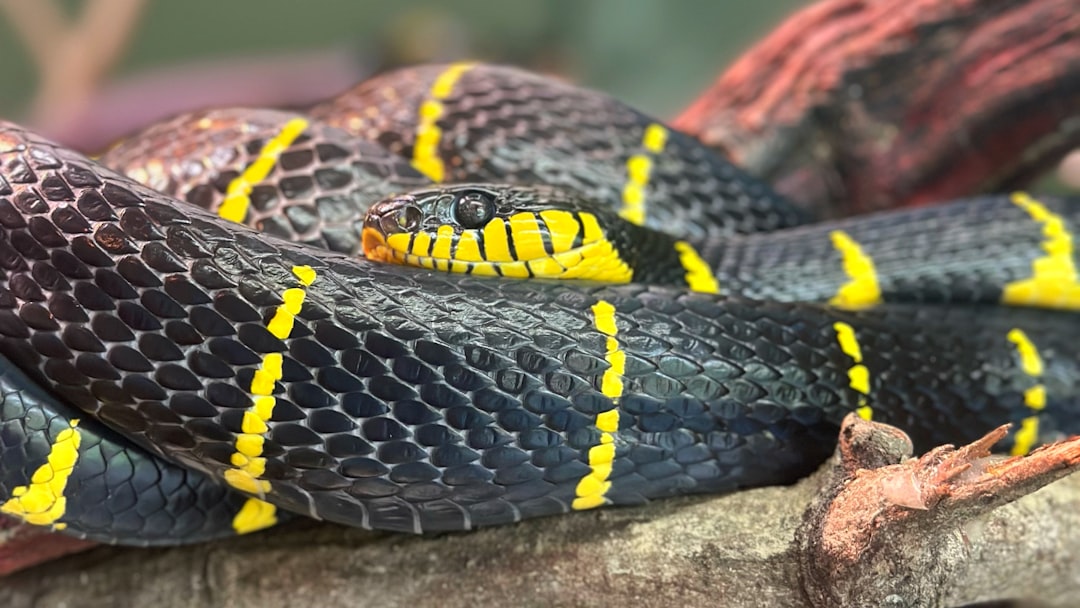
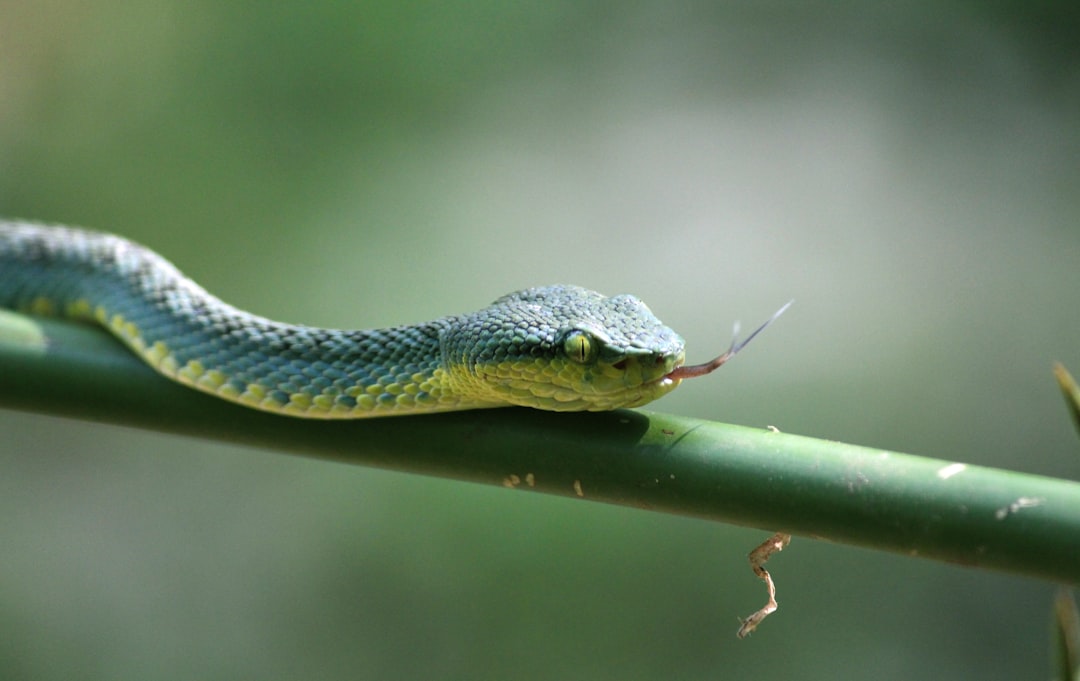
Biologists refer to this specific pattern as Batesian mimicry: a harmless species benefiting from resembling a harmful or unpalatable one. The classic examples are harmless king snakes that resemble venomous coral snakes and hoverflies that look like bees. The snake mimic caterpillar is the larval version of the same principle.
Because the underlying genetic instructions shape both body and behavior, selection can tune not just what the caterpillar looks like, but how it moves when alarmed. Over geological time, this produces the uncanny, almost “designed” appearance you see in videos.
Why is this mimicry useful and is the caterpillar dangerous?
For a soft bodied animal that cannot run fast, bite, or sting, intimidation is one of the only defenses available. The snake mimic caterpillar faces a lineup of predators that includes birds, lizards, frogs, and small mammals, many of which can easily kill and eat a caterpillar in a single bite. Even a glancing peck can be fatal.
By suddenly becoming a “snake,” the caterpillar taps into a powerful avoidance response. Birds in particular appear to be put off by big, forward facing eyes and triangular “heads,” which often signal a predator instead of prey. In the dense foliage of a rainforest, where a bird has only a fraction of a second to decide whether to snatch something, a convincing snake signal is often enough to make it move on to safer food.
Importantly, the caterpillar itself is harmless to humans. It has no venom and no fangs. If you touched one while it was displaying, it might bump into your finger or gently strike, but it cannot inject toxins. Its dramatic costume is purely defensive. According to accounts summarized by National Geographic and other outlets, this hawk moth larva lives only ten to thirty days before pupating, and it spends just a short window of that time in the late larval stage where the snake display is at its best.[National Geographic feature][Field report]
From the caterpillar’s perspective, every successful bluff is a life saved. Even if the display fails occasionally, the individuals for which it works more often will leave more offspring, and that is all evolution requires.
Where are snake mimic caterpillars found and what do they become?
Hemeroplanes triptolemus and close relatives live in tropical forests in Central and parts of South America. They have been recorded in countries such as Costa Rica, Belize, Guatemala and Mexico, and likely occur more widely wherever their host vines grow.[Distribution data] Like most moth caterpillars, they spend their days feeding on specific host plants, including species in the dogbane family such as Fischeria panamensis and related vines.[Host plant records]
After the larval stages, the caterpillar pupates, forming a chrysalis from which the adult hawk moth emerges. The adult moth looks nothing like a snake. It is a streamlined brown insect with narrow wings and a long proboscis used for sipping nectar from flowers at night. The elaborate snake disguise is a one stage specialty of the caterpillar, optimized for the time of life when it is slow, conspicuous, and especially vulnerable.
Other species in the same genus, such as Hemeroplanes ornatus, show similar but slightly less extreme snake mimicry. In that species, the underside of the body bears false eyes and the caterpillar puffs up its head and thorax when disturbed, again producing a snake-like image that can strike at predators.[Related species description] This suggests that the snake mimic strategy evolved once in the group and was refined differently in each species.
What does the snake mimic caterpillar tell us about evolution?
Seeing a caterpillar that looks “exactly” like a snake can make evolution feel almost supernatural, as if there had to be intent or planning. In reality, that impression is part of the story. Human brains are very good at spotting agency and design, and our pattern recognition locks on to the similarity. But from a biologist’s viewpoint, snake mimic caterpillars are one of many examples showing how far gradual adaptation can go when the stakes are survival.
First, they show how multiple traits can evolve together. It is not just pigment or just behavior. It is the integration of body shape, color, eyespots, inflation mechanics, and instinctive motion into a single defensive display. Each trait is controlled by genes, and combinations of those genes can be favored together when they cooperate to solve the same problem.
Second, they are a vivid case of how predator psychology shapes prey evolution. What matters is not some abstract resemblance to a snake, but what a bird or lizard sees in a fraction of a second. Eyespots, head shape, and movement tap into that predator’s built in rules like “avoid animals with big forward eyes” or “do not risk attacking something that looks like a viper.” Studying animals like Hemeroplanes helps scientists understand how visual signals and instinctive fears coevolve.
Finally, snake mimic caterpillars are a reminder that our own sense of “too perfect to be random” is not a reliable guide to how evolution works. The random part is the appearance of variation; the strongly non random part is which variants survive and reproduce. Given millions of years and intense selection, natural processes can generate outcomes that feel eerily intentional to us, whether that is a caterpillar that looks like a snake or a leaf insect that vanishes against a tree.
Your browser does not support the video tag.