
The big move in YouTube AI labels is not the box. It is YouTube AI labels becoming something the platform can apply on its own, starting in May 2026, when its systems detect significant photorealistic AI even if the uploader stays quiet. The rest of the day is a reminder that the weak point is usually not the headline system, but the layer around it: backups, cloud storage, and unverified claims dressed up as product proof.
YouTube AI labels move into automated enforcement
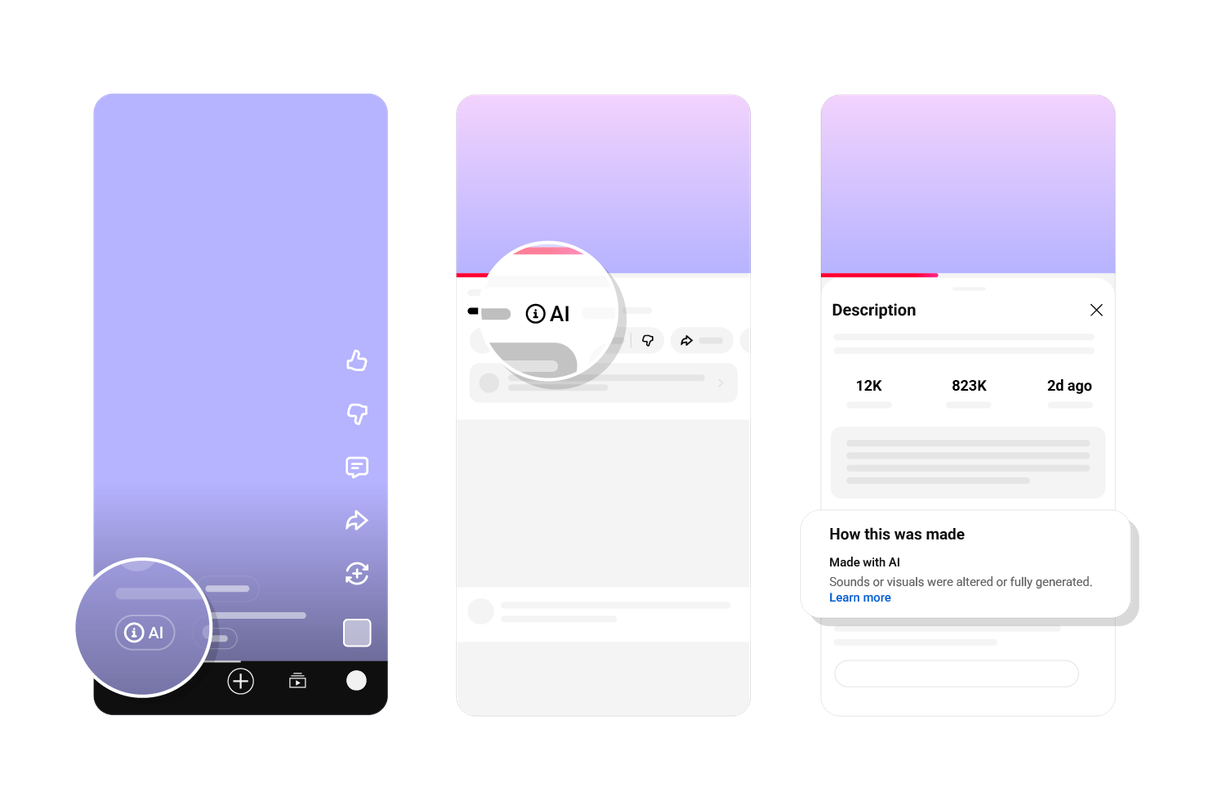
YouTube said on May 27, 2026 that it will start using internal signals to identify AI-generated content and automatically apply labels when creators do not disclose significant photorealistic AI use, per YouTube’s blog post. The company is also moving labels into places viewers might actually see them: directly below the player for long-form videos, and as an on-video overlay for Shorts. For content made with YouTube tools like Veo or Dream Screen, or content carrying C2PA metadata, labels can be effectively permanent.
This is an enforcement upgrade, not a brand-new policy. YouTube’s Help Center says creators already had to disclose meaningfully altered or generated photorealistic content, and non-disclosure could already lead to manual labels, removal, or suspension from the YouTube Partner Program. TechCrunch reports the company says the new labels will not affect recommendations or monetization. For now, then, this is about visibility and automation. The next question is whether labels stay informational, or become the first step to distribution rules.
Phishers target Signal recovery keys instead of encryption

Hackers are impersonating Signal support and telling users their backed-up chats and media are at risk of permanent loss unless they share the recovery key for online backups, according to TechCrunch. Josh Rogin posted an example on May 27, 2026, and said several anti-CCP activists received the message. Access Now’s Mohammed Al-Maskati told TechCrunch that two other people outside that community reported similar phishing attempts, which suggests the campaign is not confined to one target set.
The attack does not break Signal’s encryption. It asks users to hand over the secret needed to restore cloud backups, then still requires account takeover to finish the job. Signal’s position is blunt: it will never contact users first and will never ask for a registration code, PIN, or recovery key. The lesson is familiar and still expensive. Secure defaults do not help much once backup and recovery flows become social engineering targets.
Waymo puts a purpose-built robotaxi into service

Waymo said it will offer public rides in a new autonomous vehicle called the Ojai, a four-seat minivan built specifically for robotaxi use with Zeekr, according to Bloomberg. The vehicle will first go to select riders in San Francisco, Los Angeles, and Phoenix, and the rides will run without human supervision. Waymo and Zeekr announced their partnership in 2021.
That makes this more than another fleet refresh. A purpose-built vehicle changes the cost and operating assumptions behind the service itself, because the car is no longer a consumer vehicle with autonomy added later. It also adds a geopolitical wrinkle, since Zeekr is part of Geely, the China-based automaker building the platform.
Prison telecom vendor left 300,000 IDs exposed
Pay Tel secured a publicly exposed Microsoft Azure storage server after UpGuard found at least 300,000 driver’s license scans and other government-issued identity documents on the open web, according to TechCrunch. The server had no password. UpGuard said the exposed data also included profile photos, inmate communications such as text messages and handwritten notes, and financial records. Some uploaded photos contained precise location data, in some cases detailed enough to identify a home address.
UpGuard said it alerted Pay Tel on May 7 and followed up days later before the server was secured. TechCrunch reports Pay Tel did not respond to questions, and it is unclear whether affected people will be notified or whether attorneys general will be alerted under state breach laws. This is also Pay Tel’s second known security lapse in as many years, after a ransomware attack in June 2025.
Anthropic pushes large-codebase workflows, but not this number
Anthropic is clearly leaning into Claude Code, managed agents, and large-codebase workflows. Anthropic’s blog shows a cluster of related posts in May 2026, and its release notes say Claude Sonnet 4.6 includes a 1M token context window in beta, per Anthropic’s own documentation. InfoQ also reported Anthropic’s Code with Claude 2026 event on May 6 included Bun among the companies in that space.
What the notes do not support is the headline claim that Claude orchestrated a 750,000-line Bun rewrite from Zig to Rust. The research here traces that figure to a May 10, 2026 Byteiota commentary piece, not to an Anthropic canonical page or a major newsroom report. So the safe read is narrower: Anthropic is marketing codebase-scale agentic workflows aggressively, and Bun is part of that orbit, but the most viral benchmark attached to the story is still unverified in the sources reviewed.
A lot of today’s risk sat in the supporting systems. That is usually where the cleanup bill starts.
Key Takeaways
- YouTube will start applying AI labels automatically when it detects significant photorealistic AI content.
- Signal phishing attempts are targeting recovery keys for backups, not encryption itself.
- Waymo is rolling out a purpose-built robotaxi called the Ojai with Zeekr.
- Pay Tel exposed hundreds of thousands of identity documents in a publicly accessible cloud server.
- Anthropic’s codebase-scale workflow push is real, but the 750,000-line rewrite claim is not confirmed.
Sources
- YouTube Will Auto-Label AI Videos at Scale, blog.youtube
- Phishers Found the Weak Point in Signal Backups, techcrunch.com
- Waymo Put a Purpose-Built Robotaxi on Public Roads, bloomberg.com
- Prison Phone Vendor Exposed 300,000 Caller IDs, techcrunch.com
- Anthropic Says Claude Orchestrated a 750k-Line Rewrite, claude.com
Related reading
- DeepSeek Tests Open Model Economics; Foreign Coauthors (2026-05-23)
- Canva’s AI pivot deepens just as the senior team walks (2026-05-26)
- Heretic Turns Guardrails Into Forks; AI Security Adds Another Alert Stream; Transformer Doubt Goes Public (2026-05-26)