
To get a free 55-inch 4K HDR television from Telly, a household hands over its income range, its insurance provider, what cars it owns and whether they are leased, and a credit card. In return it receives a television with a second screen bolted underneath the first one. The lower strip carries advertising. It runs while the family watches the football, or a film, or a streaming service the household is already paying to keep ad-free. The agreement says the household may not cover it.
That is the deal, and it is offered to people for whom the alternative — walking into a shop and buying a television — is not available. Anyone with the money buys a set and never sees this contract. Anyone without it is invited to pay in a different currency: the attention of everyone in the room, for as long as the television is on, plus a file on the household, and a card on file against the set’s $1,000 value if they ever try to give it back.
The price of not having the money
Telly’s hardware proposition is straightforward. Its upper “Theater Display” is the normal 55-inch television; the lower “Smart Screen” is a separate strip for information and ads. The company says the second display also supports weather, sports scores, video calling, games, music, fitness features and an AI voice assistant. Its explanation of who pays is less complicated:
“Brands pay for the non-intrusive ad on the second Smart Screen. Those ads pay for Telly. Plain and simple.”
The adjective non-intrusive is doing heroic work. The ads sit beneath whatever a household has chosen to watch, and AdExchanger reported that the lower display stays active for news and advertising rather than appearing as an occasional sponsored tile on a home screen. It is a permanent commercial channel installed in the room where a family spends its evenings, and it is on whenever the television is.

Nothing in the public record shows that low-income households make up most of Telly’s customers. The company tells advertisers the opposite — that its households over-index on income and education, which is what an advertiser wants to hear about an audience it is being sold. Who has taken the offer up so far is a separate question from what the offer is. The offer is a television for people who cannot buy one, and its price is a condition wealthier households can decline by reaching for a wallet. Privacy, and an evening without advertising in it, are being sold back to the people who could not afford the hardware in the first place.
The company says 98% of customers are satisfied and nine in 10 prefer its ads to traditional television ads. Its advertiser page does not disclose the sample, dates or methodology behind either figure. Those are marketing claims about how welcome the arrangement is, made by the party selling it.
You may not cover the ad screen
The strip is not optional once the set is in the house. Telly’s service agreement says a user must not “cover or otherwise attempt to disable” the second screen, as reported by ecoustics when the first sets shipped. Draping a cloth over it is a breach of contract.
That clause is worth sitting with, because a company does not write an enforceable term against something nobody would do. A parent watching a children’s programme with a four-year-old, with a strip of pharmaceutical and gambling advertising running underneath it, is going to want that strip covered. Telly knew that before the first set shipped, and wrote the term anyway. Family time is not an exception to the deal; it is the inventory.
The enforcement runs through the card. Telly’s terms of service say a customer who stops using the service must return the products, and that “failure to return Products to Telly will result in Telly charging the credit card on file” — the card every household must supply to receive a “free” television. Telly’s chief strategy officer, Dallas Lawrence, put a number on it: “Consumers who violate our terms and conditions and refuse to return the Telly will be charged the $1,000 value of the television.” A household that took this deal because $1,000 was not available to it is the household holding that liability.
The set also carries a camera. Telly describes it as being for video calling, behind a physical shutter; ecoustics reported a sensor that detects how many people are sitting in front of the screen. What the camera and that sensor record, and whether any of it leaves the set, is not stated in the terms — a gap in the record the household signing up cannot close. A capability described loosely in an agreement is not a limit on that capability; it is room to widen it later without renegotiating anything. A company whose entire business is measuring attention has put a camera above the sofa and a clause in the contract requiring that the advertising stay visible. Whether those two things are ever joined is Telly’s decision to make, and the terms do not commit it either way.
The questionnaire and the viewing log
Before joining Telly’s reservation process, a prospective user must provide a name, home address and valid US mobile number, install the mobile app, create an account and complete a survey. The company’s website and pre-order privacy policy list a remarkably broad set of survey categories: age or date of birth, education, residential status, vehicle ownership, income range, and TV, shopping, travel and dining habits. Gender, ethnicity and voter-registration status are listed as optional fields; the public policy does not say every questionnaire response is compulsory.
Telly also collects contact details, device and IP information, identifiers and survey data, and says it can use this for interest-based advertising, cross-context behavioral advertising and targeted advertising, disclosing information to advertising partners, analytics partners, service providers and business partners. California’s Notice of Financial Incentive states the exchange without decoration: the free connected TV and services are a financial incentive offered in return for the right to use personal information.

Then comes the television itself. Telly’s Viewing and Activity Data Policy Supplement defines Viewing Data as information about audio and video content, channels, viewing duration, apps, games and ads served, and says it can be associated with an IP address and unique device number and potentially linked to a Telly account. Activity Data reaches past the screen: searches, preferences, apps opened, transactions, and the timing, frequency and duration of sessions. Telly and authorized data partners may use all of it for analytics, audience measurement, recommendations, advertising and product improvement.
Automatic content recognition is the connective tissue. Independent researchers describe ACR as Shazam-like technology that periodically captures what is on a TV screen and matches it against a reference library. In practice it tells an ad system what a household is watching even when the programme arrived from a cable box, a games console or somebody else’s streaming app. Nor is the screen the limit of what a television can see: an LG set scans the home network and lists the unrelated devices on it, which is the same instinct pointed at a different surface.
Telly says shared Viewing and Activity Data is in an “unidentified format” and that authorized partners may not try to re-identify it. The same policy says Viewing Data may be disclosed for targeting other devices sharing the television’s IP address. That is not anonymity as a household would understand the word. It is advertising aimed at every phone and laptop behind one home internet connection, from what the television saw.
Opting out is not a settings toggle. A customer who opts out of sharing Viewing and Activity Data must stop using and return the device, and the California notice repeats it: withdrawing from the incentive ends the right to use the Telly and requires its return. Consent here is not something a household can revise after living with the product. It is the product.
What the public record does not say is which named ad buyer receives which category of household data, how long device-level records are kept, or whether survey answers travel directly into an ad bid request. Telly’s separately linked Product Terms and Product Privacy Policy were not text-accessible in the current public crawl, and its pre-order policy says device practices can vary by version and state.
The ads go up for auction after Telly misses its number
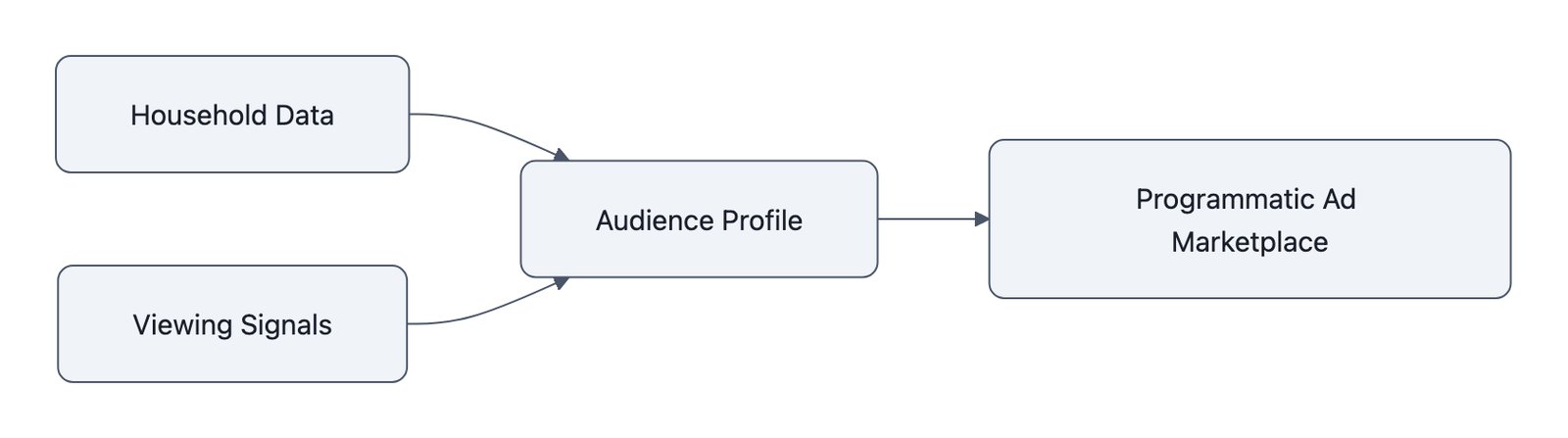
On September 9, 2026, Telly made advertising on its Home Screen programmatically buyable through Magnite’s SpringServe platform. Rather than arranging each campaign with Telly directly, advertisers can now buy the inventory through private marketplace deals, including five-minute placements. AdExchanger reported that The Trade Desk, Teads and other buyers supply the demand, and that Telly combines questionnaire information — income, household size, brand preferences, insurance provider, vehicle details, whether a car is leased or owned — with ACR-derived viewing signals for targeting.
Whether Magnite, The Trade Desk or Teads ever hold raw questionnaire answers or identifiable ACR records from an individual home is not something the public record shows. What it does show is narrower and still consequential: the living room is now wired into the infrastructure that lets thousands of buyers target and measure audiences at scale, at auction, in five-minute slices.
The timing is awkward for Telly’s growth story. A November 2025 investor update reviewed by Lowpass reportedly showed about 35,000 sets in homes at the end of the third quarter, up from 28,000 the quarter before. Telly said in 2023 it expected to ship 500,000 before that year was out. The company declined to comment on the specifics of the investor update, which reportedly also suggested Telly intended to order another 100,000 units from Foxconn. An intention is not an order, and 35,000 installed sets is not a mass-market breakthrough.
So the company has a fifteenth of the audience it promised, a fixed cost per set, and revenue that arrives per impression on one strip of screen. That is the position from which it opened the strip to the open market.
Where this goes
This site’s reading of the arrangement: it is a nightmare, and the record is what earns the word. A television is handed to people for whom a television is otherwise out of reach. The price is advertising in their living room that the contract forbids them to cover, a questionnaire about their income, their insurer and their cars, a log of what they watch and when, a camera above the sofa doing something the terms decline to specify, and a credit card held against $1,000 they did not have.
Nothing in that arrangement pushes toward a smaller advertising strip and a larger picture. Televisions had no advertising strip; this one has a narrow one; and a company paid per impression on that strip, which cannot sell enough sets to grow the audience, has exactly one lever left that it controls alone. The next version of this deal is a bigger strip. The version after that is a screen that is mostly advertising with a window of entertainment in the corner, offered to the same households, for the same reason, on the same terms — because at no point does anyone in the arrangement have a reason to stop, and the households who take it are the households with no leverage to object.
The argument on offer is about which advertisements should be allowed to appear on the lower strip. That is not the question. The question is whether a television that cannot be looked away from, sold to people in exchange for being poor, is a thing a country should permit to be manufactured.
Key Takeaways
- Telly gives away a 55-inch television with a permanent advertising strip below the picture, funded by brands rather than by the household.
- The service agreement forbids covering or disabling that second screen, and unreturned sets are charged at $1,000 to the card every customer must supply.
- Joining requires a questionnaire covering income range, education, vehicle ownership and household habits, alongside viewing and activity logging on the set itself.
- Opting out of Telly’s Viewing and Activity Data sharing means stopping use of the television and returning it.
- On September 9, 2026, Telly opened its Home Screen advertising to programmatic buying through Magnite’s SpringServe, with about 35,000 sets installed against the 500,000 it projected for 2023.
Further Reading
- Telly, The biggest thing to happen to TV since color, Telly’s consumer description of its dual-screen television and ad-funded model.
- Telly, Advertise with Us, Telly’s advertiser pitch for targeting, measurement and Smart Screen campaigns.
- AdExchanger, TV Manufacturer Telly Touts Programmatic Home Screen Ads, Reporting on Telly’s September 2026 programmatic advertising launch.
- Telly, Viewing and Activity Data Policy Supplement, Telly’s definitions of Viewing Data, Activity Data and the opt-out consequence.
- Telly, Notice of Financial Incentive, Telly’s California disclosure describing the TV as an incentive for personal information.
- Lowpass, Scoop: Telly had only 35,000 TVs in people’s homes last fall, Reporting on Telly’s reported installed base and delivery targets.