
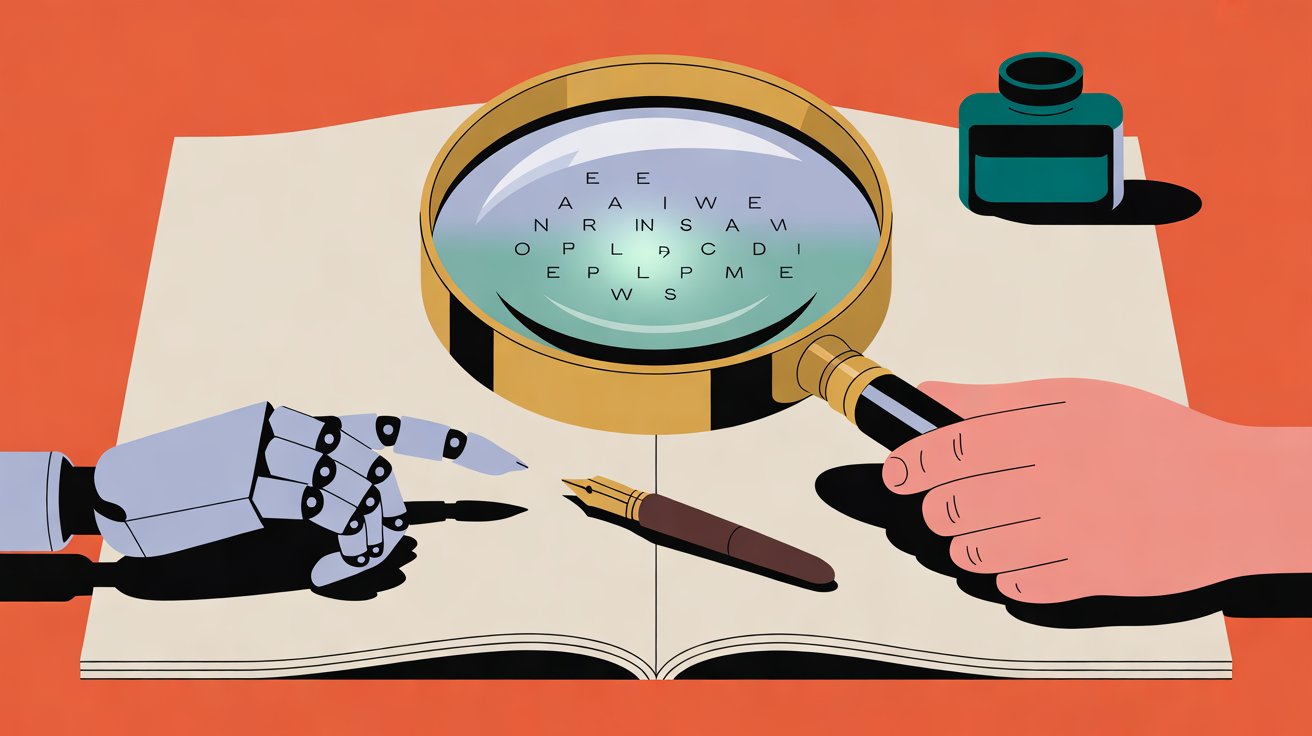
A language model writes by guessing what most likely comes next, based on everything it was trained on. So it drifts toward the average: the wording that would fit the widest range of subjects. Most chatbots are then tuned on people’s ratings to sound as agreeable as possible, which pushes the same way. Nearly every sign of AI writing comes from those two facts.
Take how a model describes a person. Its training data describes famous people in positive, important-sounding language, so it drops the specific, unusual facts, which are rare, and puts generic praise in their place, which is common. “Invented the first train-coupling device” becomes “a revolutionary titan of industry.” The text becomes less specific and more exaggerated at once: the portrait gets louder about how important its subject is while the subject fades into a blur.
Spotting it is getting harder. Each new model is trained out of the habits people have learned to mock: “delve” all but vanished in 2025, and the em dash is going the same way. Free tools now rewrite chatbot output to strip the known patterns before anyone reads it. Human writing is drifting the other way, picking up chatbot phrasing from the text people read every day. A 2025 study found people no better than chance at telling the two apart, and detection software misses most AI text once a tool rewrites it to look human. No single sign below proves anything. What still works is noticing when several turn up together in text that says little you could check.
It inflates everything
AI text attaches significance to whatever it touches. A population figure “reflects the town’s enduring role in the region.” A word’s origin “underscores a rich cultural tapestry.” A minor company “stands as a testament to innovation.” It does this to subjects with no broader importance, and sometimes admits the subject is small before explaining why it is important anyway.
Watch the ends of sentences. A plain fact followed by a clause ending in -ing (“highlighting its lasting influence,” “reflecting a broader shift”) is the model adding a verdict nobody asked for. Chatbots that search the web now pin those verdicts on real people, so you get “critics highlighted its lasting influence” whether or not any critic said so.
A person who knows the subject tells you what it did, and leaves the importance to the fact.
It describes the coverage and skips the subject
Newer models prove importance by pointing at press attention: the subject “has been featured in regional and trade publications” or “received coverage from national media.” The sources get described, and what they actually said goes missing.
Relationships blur the same way. A person writes “she ran the company from 2017.” A model writes that she was “associated with the company’s leadership,” which sounds informed and commits to nothing.
Opinions belong to nobody
“Experts say.” “Observers note.” “It is widely regarded as.” AI text credits views to unnamed authorities and inflates their number: one review becomes “critics,” one paper becomes “researchers,” and two examples are presented as the start of a long list. When a claim has an owner, a person usually names them.
It avoids “is” and “has”
People write “the station is a hub” and “the museum has a café.” AI writes “the station serves as a hub” and “the museum features a café,” or “boasts” one. These plain verbs are among the most common words in English, and chatbots swap them for something grander. One study found that use of “is” and “are” in academic writing fell by more than 10% in 2023, the year chatbots spread, after years with no change.
Its sentences are built for effect
Two sentence shapes give it away more reliably than any word. The first is the contrast that adds weight without adding a fact: “It’s not just a museum, it’s a living archive.” “This isn’t about money. It’s about trust.” The second is the group of three: “innovative, resilient and forward-looking,” three short phrases that make a thin point look thorough. Both are most telling where nobody would normally bother, such as a quick note or a comment.
Watch the ending too. A piece that closes with a “challenges” passage (“Despite its success, the company faces several challenges…”) and then a hopeful word about the future is an outline being filled in.
Its vocabulary dates it
Certain words turn up far more often in text written since chatbots became common, and they arrive in waves as the models change. From 2023 to mid-2024 the giveaways were delve, tapestry, testament, pivotal, underscore, intricate and vibrant. From mid-2024 to mid-2025 they were fostering, showcasing, enhance and crucial. Since mid-2026 they have been quietly, matters, leverage, multifaceted and dependable, in shorter sentences that rarely run past 20 words.
One of these words means little. Several in a short passage, especially from the same era, mean a lot. The lists keep moving because a word that becomes a famous tell gets trained out of the next model.
The formatting is a chatbot’s
Chat windows format answers to be skimmed, and that formatting survives a paste: headings in Title Case, bold scattered through ordinary sentences, bulleted lists where every item starts with a bold label, emoji at the start of headings, and curly quotation marks in a document that otherwise uses straight ones. Stray Markdown symbols such as ** or ## in a place that does not use Markdown almost always mean the text came from a chat window.
It left the conversation in
The strongest signs are the ones nobody meant to leave. “Certainly! Here is a revised version.” “I hope this helps.” “As of my last knowledge update.” Placeholders nobody filled in, such as [Company Name] or [insert date]. A sentence addressed to the person who asked for the text instead of to its reader.
Newer models leave subtler residue. When they cannot find something, they say the information “is not publicly available” and then guess what it probably is. A private person “maintains a low profile.” Since mid-2026, chatbots have also taken to warning that a source “should be treated as indicative rather than definitive,” or that the evidence “does not establish” a conclusion nobody drew.
Its sources do not hold up
Click the links. AI-written text often cites pages that never existed, so several dead links in new writing, with no copy in a web archive, is a strong sign. Academic references whose identifiers lead nowhere, or to an unrelated paper, are another. ChatGPT tags the links it finds, so a URL ending in utm_source=chatgpt.com was copied from it, though that shows only that someone used it to find sources. The most common failure is the quietest: a real source that does not say what the sentence claims.
What human writing does
People use plain words: “is,” “has,” “died” where a model writes “passed away,” “used” where it writes “utilized.” They commit to claims a model hedges away from: “the only,” “the first,” “one of the worst.” And they keep the odd specific detail a model would smooth over, because it was true and they knew it.
A person can also explain their own choices. Ask where a fact came from, or why a link is wrong, and someone who wrote it can tell you about the source they misread or the typo they made. Text written before ChatGPT launched, on 30 November 2022, is almost certainly human.
What does not give it away
Some popular tells are no help, and accusing someone on their strength is unfair. Perfect grammar proves nothing, since plenty of people write well. Formal or bland prose proves nothing either; chatbots overuse particular words, and formality in general is no sign. A mix of casual and clinical tone is as likely to come from a young writer or a technical one. Transition words such as “additionally” have always filled human essays. And a detector’s score, on its own, settles nothing.
The test that works on almost any text is the one a model is worst at. Take a sentence and ask whether it could be about something else. “A revolutionary titan of industry” could describe a hundred people. “Invented the first train-coupling device” describes one. The more a piece of writing could be about anything, the less likely it came from someone who knew the subject.
Further Reading
- Wikipedia: Signs of AI writing, the field guide kept by Wikipedia’s volunteer editors, which this article draws on, with real examples of every sign.
- The rise of AI-generated content in Wikipedia, a 2024 study estimating that up to 5% of new English Wikipedia articles carried significant AI text.