
OpenAI did slow GPT-5.6: on June 26, 2026, it launched the model only to a small group of trusted partners after White House pressure under a June 2 executive order. The practical change was simple: instead of the usual broad API or product rollout, GPT-5.6 Sol went into a government-limited preview where federal officials effectively had a say over who got in first.
That is a meaningful shift from a normal OpenAI launch. Reuters reported that OpenAI deferred a full public rollout, shared partner details with U.S. authorities, and described the step as temporary; OpenAI has also publicly pushed back on making this kind of review path the norm.
GPT-5.6 launched as a government-limited preview
The clearest evidence is the rollout itself: according to TechCrunch, OpenAI limited GPT-5.6 to a small set of trusted partners after a government request tied to safety concerns. AP similarly reported that GPT-5.6 Sol was restricted to a small group of approved partners, not opened in the familiar “everyone gets the new model” pattern.
That matters because OpenAI’s standard playbook has usually been staged but commercial: a ChatGPT tier, an API release, or both, often with usage caps but not customer-by-customer political screening. This time, reporting says access was reviewed at the partner level, which is much closer to a controlled export list than to a product beta.
TechCrunch, citing earlier reporting from The Information, said the offices pushing for the restriction were the Office of the National Cyber Director and the White House Office of Science and Technology Policy. Those are not obscure advisory desks. The National Cyber Director coordinates national cyber policy; OSTP is the White House’s science-and-technology arm. Together, they are exactly the kind of offices that can turn a “voluntary” process into one companies feel they should not refuse.
That broader pressure did not begin with OpenAI. The administration had already been pushing for early model access before public release, and Anthropic had already hit a similar wall with its frontier model suspension. OpenAI has also shown before that it will back off a launch when outside pressure rises, but GPT-5.6 is different because the brake here came through a formal federal review channel.
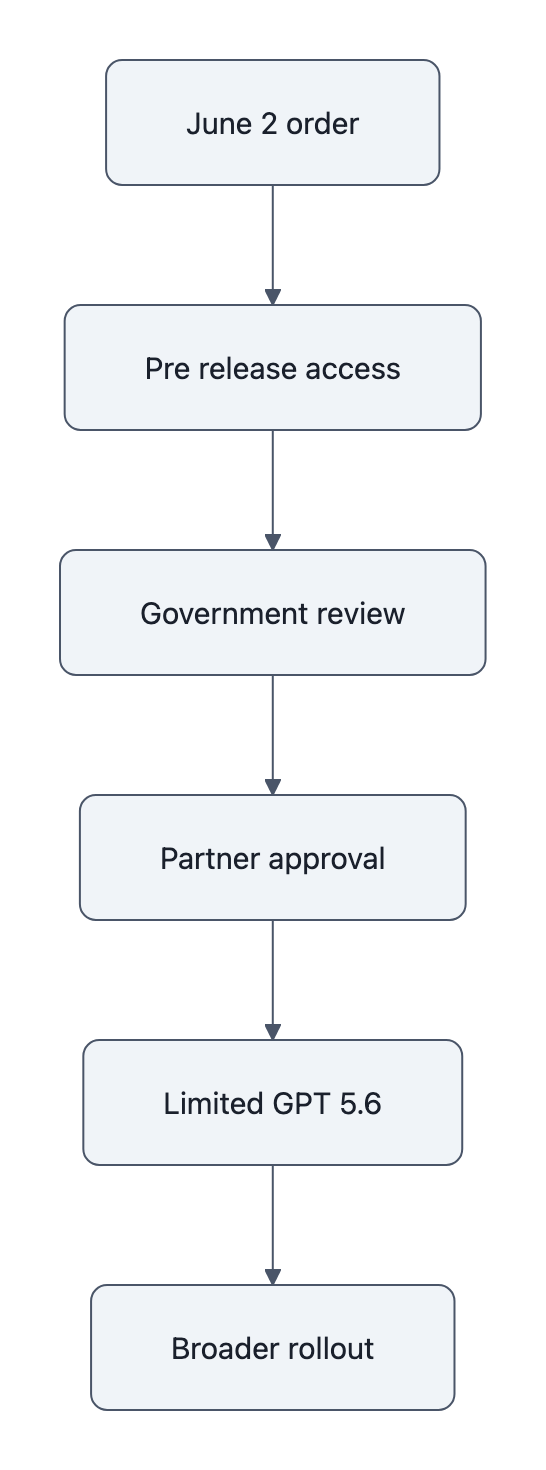
The June 2 executive order created a 30-day pre-release access framework
The legal and policy hook is the June 2, 2026 executive order, which created a framework for companies to provide the government with pre-release access to covered frontier models for up to 30 days. The order describes the framework as voluntary, but it also sets up the mechanism by which the government can review advanced systems before they reach the public.
In plain terms, the order creates a waiting room for the most capable models. If a system is designated a covered frontier model, the government can ask to see it before everyone else, evaluate safety and security concerns, and shape the conditions of release. Some of the details that determine exactly how models will be benchmarked or designated remain classified or undefined, which means companies are operating within a framework whose sharpest edges are not fully public.
Reuters reported that OpenAI shared details about its launch partners with authorities as part of this process. OpenAI has not publicly named those initial partner companies. That omission matters because it leaves outsiders unable to see whether the preview was genuinely narrow, strategically selective, or politically filtered.
The order’s language is softer than a licensing regime, but the effect can look similar. If the White House gets early access, sees the partner list, and strongly signals that only certain customers are acceptable, then “voluntary” starts to function like prior approval. That is not a formal license on paper; it is a choke point in practice.
OpenAI says the review path is temporary, but critics call it de facto licensing
OpenAI’s position, as reported by TechCrunch, is that the GPT-5.6 restrictions “shouldn’t be the norm”. That is an important signal from the company itself: OpenAI appears to be complying, but not happily endorsing a permanent federal pre-clearance lane for frontier releases.
AP’s framing was blunter: GPT-5.6 Sol reached only “Trump-approved customers” during review. Even if that wording compresses a messier internal process, the core fact stands. The first people through the door were not simply the first paying users or the first enterprise customers ready to integrate; they were the ones acceptable inside a federal safety review regime.
That is why the strongest answer to the bigger question is yes: early government access is starting to look like a de facto control point for frontier AI launches. Not because the White House has published a clean licensing law, but because companies now have a credible reason to treat federal sign-off as part of the shipping checklist. Once that norm exists, refusing it becomes much harder than agreeing to it once.
There is still uncertainty around how durable this system will be. Much of the reporting on who specifically pressed OpenAI came from media reports citing sources familiar with the matter rather than a full public memo, and some of the most important technical criteria for covered frontier models remain opaque. But for GPT-5.6, the practical outcome is already visible: OpenAI shipped later, to fewer people, through a government-screened lane.
The next test is whether GPT-5.6 expands quickly to normal commercial access or whether this “temporary” process hardens into the default path for top-end models. That answer will likely come with the next covered frontier release, not with this one.
Key Takeaways
- OpenAI limited GPT-5.6 on June 26, 2026, to a small group of trusted partners rather than doing a normal broad launch.
- Reporting says the White House offices involved were the Office of the National Cyber Director and OSTP.
- The June 2, 2026, executive order created a voluntary pre-release access framework of up to 30 days for covered frontier models.
- OpenAI says this review path should not become the norm, but the rollout already functioned like a practical gatekeeping system.
- OpenAI has not publicly named the initial GPT-5.6 partner companies that received access.
Further Reading
- OpenAI limits GPT-5.6 rollout after government request, says restrictions shouldn’t be the norm, TechCrunch on the limited launch and OpenAI’s objections to making it standard.
- The White House is asking OpenAI to slow-roll the release of its new model over safety concerns, TechCrunch on the White House offices involved and the customer-approval process.
- Promoting Advanced Artificial Intelligence Innovation and Security, The June 2, 2026, executive order establishing the pre-release access framework.
- OpenAI limits latest ChatGPT product to Trump-approved customers amid review, AP on the restricted GPT-5.6 Sol preview and the broader policy context.
- OpenAI defers public rollout of GPT-5.6 as US seeks early access to frontier AI models, Reuters on the delay, partner disclosures, and OpenAI’s framing of the move as temporary.