

Sony Music Publishing and Warner Chappell Music sued Anthropic, CEO Dario Amodei and co-founder Benjamin Mann on August 28, 2026, alleging that Claude was built and operated with unlawfully obtained song lyrics, sheet music and other musical compositions.
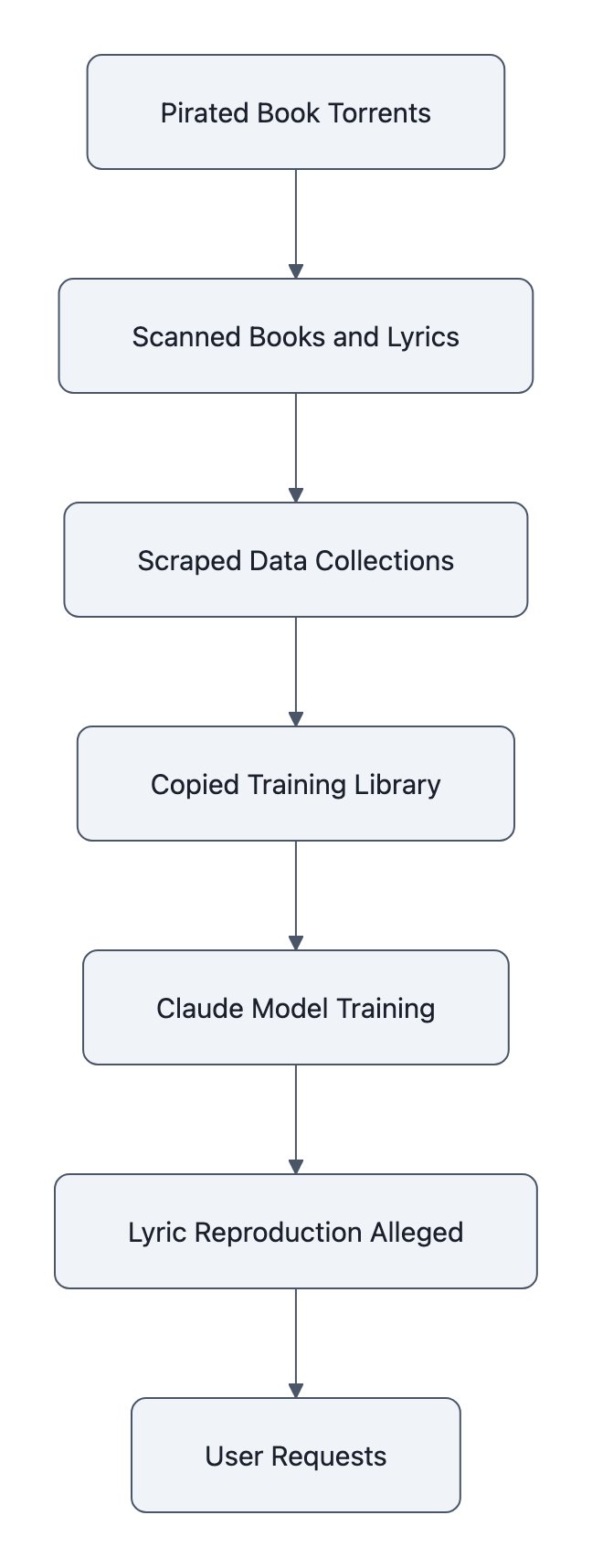
The publishers say Anthropic acquired works through pirate-book torrents, web scraping and scanned books, then used them to train Claude and allegedly produce copied lyrics for users. This is a lawsuit over songwriting and publishing rights, not master recordings owned by record labels. Anthropic had not responded to a request for comment before TechCrunch published its report.
The lawsuit says Anthropic took songs people wrote and published, fed their words into an AI system, and let that system hand versions of those words back to users. The complaint seeks a jury trial, an accounting of Claude’s training data and methods, destruction of infringing copies, a permanent injunction, legal fees, and damages.
“Among the innumerable copyrighted works Defendants illegally harvested to fuel Claude are thousands upon thousands of Music Publishers’ copyrighted musical compositions.”
, Sony Music Publishing and Warner Chappell Music complaint
The plaintiffs name compositions including “Ain’t No Mountain High Enough,” “All I Want for Christmas Is You,” “Eye of the Tiger,” “Paper Rings,” “Livin’ on a Prayer,” “September” and “Hallelujah”. The filing’s lists are expressly illustrative and non-exhaustive, however, and a court has not yet found Anthropic liable.

The complaint alleges torrenting, scraping and lyric-generating Claude outputs
The publishers’ central allegation is that Anthropic built a library of copied text by torrenting at least five million pirated books from LibGen in June 2021 and at least two million from PiLiMi in July 2022. Books in those collections allegedly included lyrics and sheet music for hundreds or more protected songs.
The complaint further alleges that Anthropic:
- Scraped lyrics from sites including MusixMatch and LyricFind.
- Downloaded third-party data collections including Common Crawl, The Pile and Books3.
- Destructively scanned millions of second-hand physical books, including books containing lyrics and musical notation.
- Trained Claude on those copies and fine-tuned it in ways that allegedly encouraged lyric reproduction.
- Removed copyright-management information, such as ownership information attached to copyrighted material.
That scanning allegation overlaps with Anthropic’s scanning of millions of bought books, a practice that has made “we bought a copy” a much less complete copyright defense than it first sounds.
The complaint puts special weight on outputs. It alleges Claude can generate verbatim or near-verbatim lyrics from protected songs, as well as derivative versions. That claim matters because it moves the dispute beyond the still-contested question of whether training itself can qualify as fair use. It alleges copying at acquisition, during training, and when customers use the product.
The suit asks for either actual damages and Anthropic’s profits, or statutory damages of up to $150,000 for each willfully infringed work and up to $25,000 for each copyright-management-information violation. Those ceilings make a multibillion-dollar headline mathematically plausible if enough violations are proved. They are not a damages award, or even a verified inventory of the allegedly copied works.
This is also not Anthropic’s first copyright reckoning over its book library. A federal judge approved a $1.5 billion settlement covering roughly 482,000 books in the Bartz case. The earlier ruling treated AI training on books differently from the alleged piracy used to obtain millions of those books, an awkward distinction for a company that may have won a fair-use argument while still paying for the library’s acquisition.
Music publishers have been pursuing the same pressure campaign for some time. Universal Music Publishing Group, Concord and ABKCO sued Anthropic over roughly 500 songs in 2023; a January 2026 complaint covered more than 20,000 works and sought more than $3 billion. BMG and Round Hill Music later filed their own cases.
The publishers are not arguing that AI is inherently unlicensable. Warner Music Group announced in November 2025 that KLAY had reached separate licensing deals with Sony Music Publishing, Warner Chappell and other music companies, with KLAY saying its model was trained entirely on licensed music. Warner also settled litigation with Udio and announced a licensed AI music-creation service.
Those are Warner-controlled accounts of separate licensing arrangements, not evidence that Anthropic received, or rejected, a comparable offer. But they make the publishers’ position clear enough: the preferred AI training dataset is one they can invoice for. The alternative is a courtroom fight over how the data got there, much like the Meta AI copyright lawsuit.
Key Takeaways
- Sony Music Publishing and Warner Chappell Music sued Anthropic, Dario Amodei and Benjamin Mann on August 28, 2026.
- The case concerns compositions, lyrics and sheet music rather than record-label ownership of master recordings.
- The complaint alleges torrenting, scraping, book scanning, model training and infringing Claude outputs.
- The publishers seek an injunction, training-data accounting, destruction of copies and damages.
- Multibillion-dollar exposure is a theoretical statutory-damages calculation, not an established award.
Further Reading
- 2026.08.28 Sony.Warner Complaint, Primary court filing setting out the publishers’ allegations and requested remedies.
- Now Sony Music Publishing and Warner Chappell sue Anthropic in multi-billion dollar lawsuit: ‘One of the largest and most blatant ongoing thefts of intellectual property in history.’, Music-industry context on the earlier publisher cases against Anthropic.
- Sony Music, Warner sue Anthropic, alleging a “brazen campaign” of intellectual property theft, Independent reporting on the new lawsuit.
- Judge approves a $1.5B Anthropic settlement over books used to train Claude, Reporting on the earlier book-piracy settlement.
- WARNER MUSIC GROUP SIGNS AI LICENSING DEAL WITH MUSIC TECHNOLOGY COMPANY KLAY, Warner’s account of its licensed-AI arrangement with KLAY.