

On Thursday, Jack Dorsey fired roughly 4,000 people and called it an AI story. The phrase “Block layoffs AI” shot across headlines, the stock jumped more than 20%, and suddenly this looked like the future of white‑collar work arriving on schedule.
I don’t buy it.
AI is the excuse. The move is about capital markets, not Claude.
Dorsey’s letter is best read as a signal to investors and a threat to workers, not as evidence that current AI can actually replace half of a 10,000‑person fintech company and keep the trains running on time.
Let’s unpack what this really is: a live experiment with macroeconomic downside, dressed up as inevitability.
Block layoffs AI: what Dorsey actually said and the company numbers
Start with the facts, not the vibes.
Block had a little over 10,000 employees. It’s cutting “over 4,000” roles, leaving “just under 6,000” people, according to AP and CNN. That’s nearly half the company gone in one shot.
Dorsey says the core thesis is “simple”:
“Intelligence tools have changed what it means to build and run a company… A significantly smaller team, using the tools we’re building, can do more and do it better.”
He insists “we’re not making this decision because we’re in trouble. Our business is strong.” Gross profit is up around 24% year‑over‑year; Block is taking a $450-$500m restructuring charge…and the stock blasted up 20-24% on the news.
Also important: Block hired like crazy during the pandemic. Headcount went from ~3,800 at the end of 2019 to over 10,000 before these cuts. That growth far outpaced revenue growth. A former employee on Reddit summed it up bluntly: “we’d run out of levers to pull for profit growth years ago… Our last resort was shrinking expenses.”
Now layer in the AI claims:
- Internal LLM tooling (“Goose”) described by an ex‑employee as “just a GPT wrapper with a Datadog integration”
- AI investments that really only ramped up in late 2024
- Zero public evidence that Block has production‑grade, deeply integrated automation replacing core functions end‑to‑end
If AI suddenly made half the staff redundant, it did so in under a year, with commodity tooling, at a company that was, by its own alumni’s account, late to the party.
Technically possible? Maybe in edge pockets.
Operationally credible? No.
This is AI spin: how to see the market signal hiding in plain sight
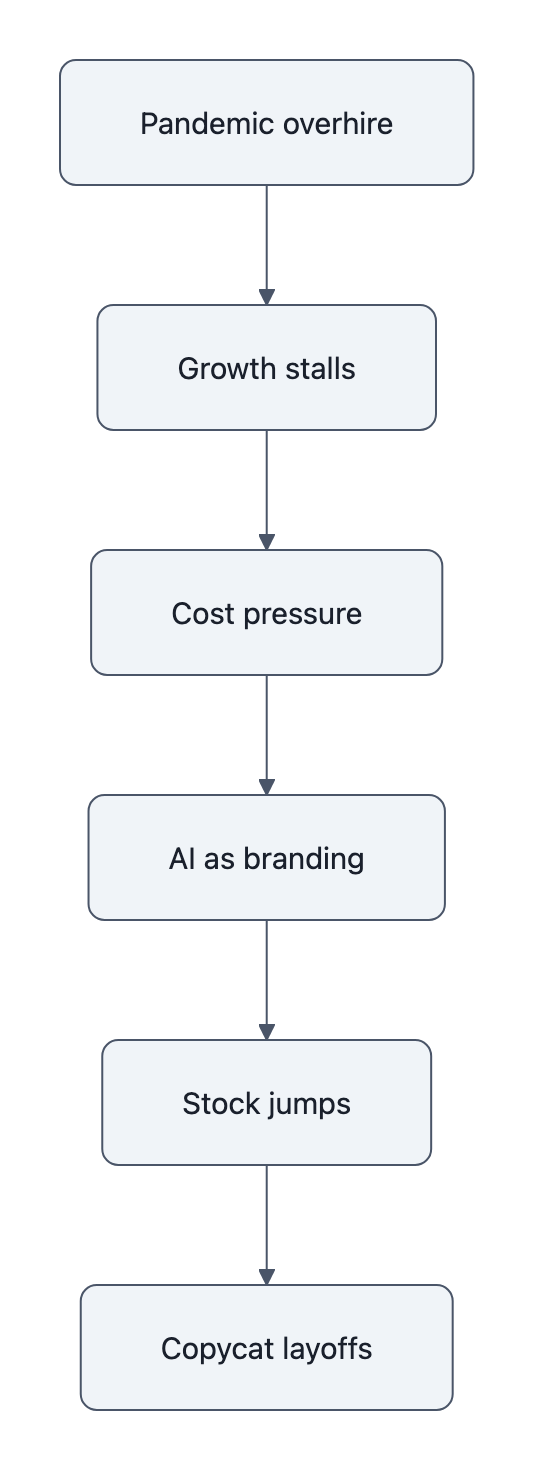
If you strip out the AI language, what’s left looks very old‑school: a company that over‑hired into a pandemic sugar high, watched growth stall, and finally did the brutal cost reset Wall Street had been craving.
The difference is branding.
In 2021, a CEO doing this would say “rightsizing for long‑term efficiency.” In 2026, you say “AI lets us do more with less.”
Because that one word, AI, does three valuable things for management:
- Turbocharges the stock reaction
“We have a bloated cost base” is not a 24%‑pop line. “We’ve harnessed AI to become a lean, future‑proof machine” is.
Investors aren’t just cheering cost cuts; they’re assigning a higher multiple to future earnings because they think margins will structurally improve. Call it AI‑multiple arbitrage.
- Shifts blame from management to destiny
If you say “we screwed up hiring,” you admit failure.
If you say “intelligence tools have changed what it means to run a company,” suddenly you’re a brave realist doing what others won’t. People lost their jobs because of “the march of technology,” not because senior leadership chased pandemic‑era growth and missed on product bets (Cash App and Square “stalled,” per that ex‑employee).
- Creates pressure on everyone else to copy you
Dorsey didn’t just say we did this. He said:
“Within the next year, I believe the majority of companies will reach the same conclusion and make similar structural changes.”
That’s not a prediction. It’s an invitation.
If you’re a CFO at a mid‑cap SaaS company already doing quiet layoffs for more boring reasons, this hands you a narrative upgrade: turn your cost‑cut into an “AI transformation,” get rewarded like Block did, and you’ve just manufactured shareholder goodwill out of human anxiety.
This is AI spin: taking moves you were going to make anyway, reversing over‑hiring, centralizing functions, flattening org charts, and retrofitting them with an AI story, because AI stories price better.
What this actually means for workers, investors and product teams

So if “Block layoffs AI” is mostly market signalling, what changes on the ground? More than you might think, but not in the way Dorsey promises.
For workers
In the short term, nothing about your actual tools justifies panic about half of white‑collar work disappearing in a year.
If you’ve read analyses like Can AI already replace 11.7% of the U.S. workforce?, you know the current frontier is task‑level substitution, not whole‑job deletion. LLMs draft, summarize, prototype. They don’t independently own revenue, risk, or regulation.
But the narrative absolutely changes your bargaining position.
When a CEO can point to Block and say “everyone’s doing this,” it becomes easier to:
- Freeze hiring while claiming “AI productivity” fills the gap
- Offload grunt work onto junior people plus tools, then later declare those roles redundant
- Tie performance expectations to unrealistic assumptions about what your “AI‑augmented” output should be
Your move: document your workflow. Know exactly which parts of your job are:
- Mechanical and automatable today
- Judgment‑heavy and brittle for LLMs
- Dependent on institutional knowledge / relationships
The more you can explicitly show “this is the value I create that tools can’t reliably handle yet,” the harder it is to wave you away as generic overhead.
For investors
Treat Block as a stress test, not as a proof point.
On paper, this should be beautiful: higher gross profit, massive cost takeout, AI‑boosted productivity. In practice, we don’t know yet:
- Does product velocity actually improve with half the staff gone?
- Do incident rates, fraud, or compliance issues quietly climb?
- Does customer satisfaction tank when the people who knew how to debug the weird edge cases are gone?
You’ve seen this movie in other industries: aggressive “efficiency” stories that look amazing for 3-4 quarters, then regress when reality hits. Remember when airlines were “lean and agile” until they weren’t?
If you want to go deeper on how fragile AI reliability still is, there’s a good primer in Are large language models reliable for business use?.
The rational investor stance right now is: discount the AI story, model the cost save, and watch execution like a hawk.
For product and engineering teams
This is the part nobody wants to say out loud: a lot of “AI‑driven restructuring” is building on sand.
Ex‑Block employees describe their tooling as minor productivity sugar, not a new nervous system for the company. That’s what most internal deployments look like: scattered copilots, some workflow glue, the occasional RAG service duct‑taped to Notion.
If your execs start talking like Dorsey, your question shouldn’t be “how do we get 2x faster?” It should be: “What, specifically, are we going to stop doing or degrade in quality, and who is responsible when the tools fail?”
Otherwise you’re signing up to be the human safety net for a ghost workforce that only exists in the slide deck.
How to spot real AI‑driven restructuring vs PR: a short checklist
You’re going to see more “Block layoffs AI” announcements. Here’s how to tell if they’re actually tech‑driven or just financial cosplay.
1. Lead indicator: did the AI come before the cuts?
Real: The company has been investing for 12-24 months in internal tooling, has clear adoption metrics, and can show prior headcount freezes or role reshaping tied to those tools.
PR: AI spending only ramped in the last couple quarters. Most of the “AI” is wrappers around OpenAI/Anthropic with vague talk of “experiments.”
2. Granularity: can they name the workflows, not just the buzzwords?
Real: They say “We automated X% of customer support tickets of types A, B, C” or “We eliminated 80% of manual reconciliation in this process.”
PR: They say “AI has changed what it means to run a company” and throw around “smaller, highly talented teams” without naming a single end‑to‑end process that’s now machine‑owned.
3. Accountability: is there explicit risk ownership?
Real: There’s a VP whose job is “AI operations” or similar, with clear SLOs: error rates, incident budgets, regulatory reporting. Post‑cut, they show you how they’ll catch failures.
PR: Risk is hand‑waved. The only hard numbers are severance cost, restructuring charges, and projected margin improvement.
4. Time profile: do they promise step‑function gains or compounding ones?
Real: They say “We’re seeing 3-5% quarterly productivity improvements from better tools and expect compounding benefits over years.”
PR: They say “We just cut 40% of staff and everything will be fine because AI.” That’s a step function in the PowerPoint, not in reality.
5. Rehiring pattern: do they quietly staff back up in 12-24 months?
This is the big tell coming for Block.
If, two years from now, the company is back near 8,000 employees with a different org chart and more automation, you’ll know this was mostly a painful reset plus some real productivity gains from tools.
If they’re stuck firefighting with 6,000 and missing roadmap after roadmap, the “AI did it” narrative will look a lot thinner.
Key Takeaways
- “Block layoffs AI” is primarily a capital markets narrative, not a demonstration that current AI can safely replace half of a fintech’s workforce.
- AI spin lets executives rebrand over‑hiring and cost cuts as technological inevitability, juicing the stock and dodging blame.
- Today’s AI can replace tasks, not most full jobs; treating Block as proof of imminent mass white‑collar automation is a category error.
- Workers and product teams should focus on mapping their actual workflows and risks, not on abstract AI hype; investors should treat this as a fragile experiment, not a guaranteed margin revolution.
- To spot genuine AI‑driven restructuring, follow the tooling timeline, workflow specifics, and rehiring patterns, not just the press release.
Further Reading
- Block lays off nearly half its staff because of AI. Its CEO said most companies will do the same | CNN Business, Straight coverage of the layoffs, Dorsey’s AI rationale and his prediction that other firms will copy the move.
- Fintech company Block lays off 4,000 of its 10,000 staff, citing gains from AI, AP, Confirms headcount numbers, quotes Dorsey’s “intelligence tools” thesis and reports the stock’s reaction and restructuring costs.
- Jack Dorsey’s Block to cut over 4,000 jobs as AI use expands, shares surge, Reuters/Investing.com, Highlights the market response, AI framing, and financial context behind the cuts.
- Jack Dorsey’s Block to cut workforce by ‘nearly half’ as it leans on AI tools, Financial Times, Places Block’s move in the broader arc of pandemic over‑hiring, tech layoffs and its bitcoin‑heavy strategy.
In a year or two, Block will either be the case study everybody cites for “AI‑powered lean companies”…or the cautionary tale of a CEO who took a chainsaw to his org chart while believing his own press release. The tools are real. The story he’s telling about them is the part you should interrogate.