
Open Amazon’s app in New York City this week and it may tell you the City Council is about to add $5 to every order. Tap through and Amazon hands you a form to “contact your council member to oppose Intro 518.” Amazon says 20,000 customers sent that email in the first six hours.
Intro 518 does not charge anyone $5. It makes Amazon the employer of the people who deliver its packages. If a New Yorker’s order costs $5 more, Amazon will have charged it.
That is a $3 trillion company using the screen its customers shop on to recruit them as lobbyists against a labor law. The emails reach council members from voters, in voters’ names. The number in them, and the money behind it, are Amazon’s.
It has worked in New York before
In July 2015 Uber added a “De Blasio’s Uber” tab to its New York app. It showed riders an empty map and long waits, the city Uber said they would get if the mayor capped its growth, and asked them to email the mayor and the Council. Six days later the city dropped the cap.
In 2020 Uber, Lyft and DoorDash ran the same play across California for Proposition 22, which kept their drivers as contractors rather than employees. Riders got pop-ups and in-app messages, some that had to be clicked through before a ride, and the companies spent about $200 million. Prop 22 passed with about 59% of the vote. Intro 518 is the same fight, over the same question: whether the company that runs the drivers has to employ them.
Amazon’s drivers, on someone else’s payroll
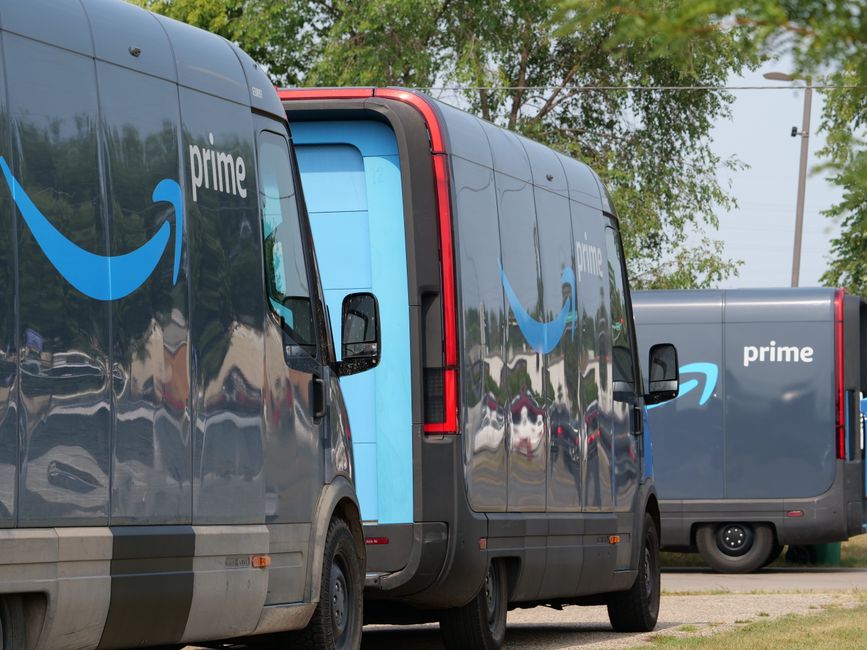
The driver who brings an Amazon parcel wears an Amazon uniform and drives an Amazon van. Amazon sets the route, the load time and the dispatch window, and watches the cab through Amazon’s cameras. But the driver’s paycheck comes from a small contractor firm, under a program Amazon started in 2018. In New York, more than 5,000 people work for about 40 of these firms out of Amazon’s depots, Amazon told the Council.
Luc Rene is one of them. He earns $25 an hour on shifts of 10 hours or more, and he told Yahoo Finance:
“On paper, Amazon’s not my employer, but in reality, Amazon is.”
Keeping them on someone else’s payroll is worth a lot to Amazon. The contractor, not Amazon, is the employer when a driver is hurt or a van crashes. The city comptroller counted 9.2 injuries per 100 full-time-equivalent workers at Amazon’s contractor firms in 2023-24, against 2.4 for private employers nationally. If Amazon ends a contract, the drivers go with it. When a regional office of the National Labor Relations Board found in 2024 that Amazon was in fact a joint employer of contractor drivers in Palmdale, California, the case ended in a 2026 settlement with a clause disclaiming exactly that.
Intro 518 would make the paper match. Amazon, and every other last-mile delivery company in the city except the Postal Service, would have to hire those workers directly and pay the city $500 a year per depot for a license. If a contractor loses its Amazon deal because of the law, its drivers get first offer of the new jobs.
Amazon paid for the $5
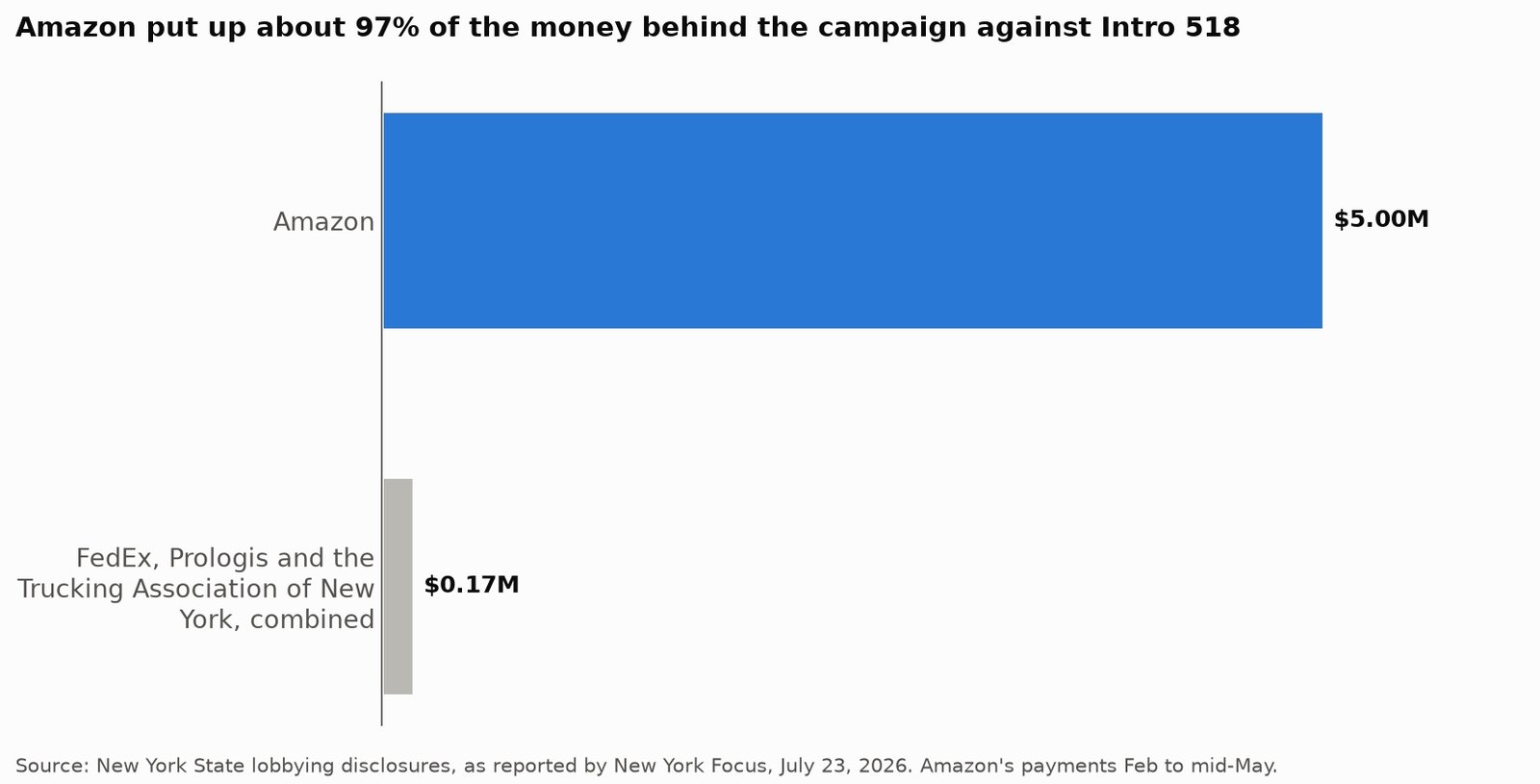
The number on the pop-up was bought. Between February and mid-May, Amazon paid $5,001,377 to a group called the Five Borough Jobs Campaign, about 97% of the group’s money this year, according to state lobbying disclosures reported by New York Focus. The campaign paid the consulting firm AKRF $52,500 for a study of what the bill would cost.
The study’s highest figure is $5.20 per package. It is the top of a range, and it comes from a scenario in which Amazon moves its depots out of the city. Even then, the market-data site Barchart found, it covers only the parcels that pass through depots inside New York, about 36% of the total. The pop-up turned $5.20 per package into “$5 per order” and never showed the working. CNBC could not verify it.
So Amazon paid for the study, the study priced Amazon leaving, and Amazon is the company that would set the price. In September Amazon described the cost as “$664 in annual delivery costs passed through to every New York City household.” The Council cannot pass a cost through to a household. Only the seller can.
For months Amazon kept its name off the campaign. About $4.7 million went to ads under the name “New York Delivers,” paid for, the disclaimer said, by the Five Borough Jobs Campaign. As late as May 19 the New York Delivers website did not list Amazon as a member. The pop-up drops the front group. Amazon now puts the message in its own app and gets its customers to send it. Its spokesperson told CNBC the notices are meant to be “transparent with our customers.” They do not tell customers Amazon paid for the number.
Only a dominant company can make this threat
A shop that has to compete for its customers cannot tell them a new law will raise its prices and then ask them to fight the law. They would shop somewhere else. Amazon can, because most of them will not.
Amazon takes about 40% of everything Americans buy online, by eMarketer’s estimate. Some 201 million Americans have Prime, paid a year ahead for its delivery. And Amazon now delivers more parcels in the United States than anyone: 6.7 billion in 2025, ahead of the Postal Service, UPS and FedEx.
Amazon owns the store, the membership and the vans, and it sets the delivery price in all three. When a company in that position names a price for a law before the law passes, its customers have nowhere comparable to take their orders. The Federal Trade Commission is suing Amazon as an illegal monopolist, with trial set for March 29, 2027. In New York this month, the same power is being turned on a city council.
And if the city says no
The pop-up says Amazon would be “forced to consider moving our operations outside of the city.” New York has heard this before. In 2019 Amazon walked away from its planned Queens headquarters and the 25,000 jobs it promised. By April 2026 it said it employed more than 25,000 people in the city anyway.
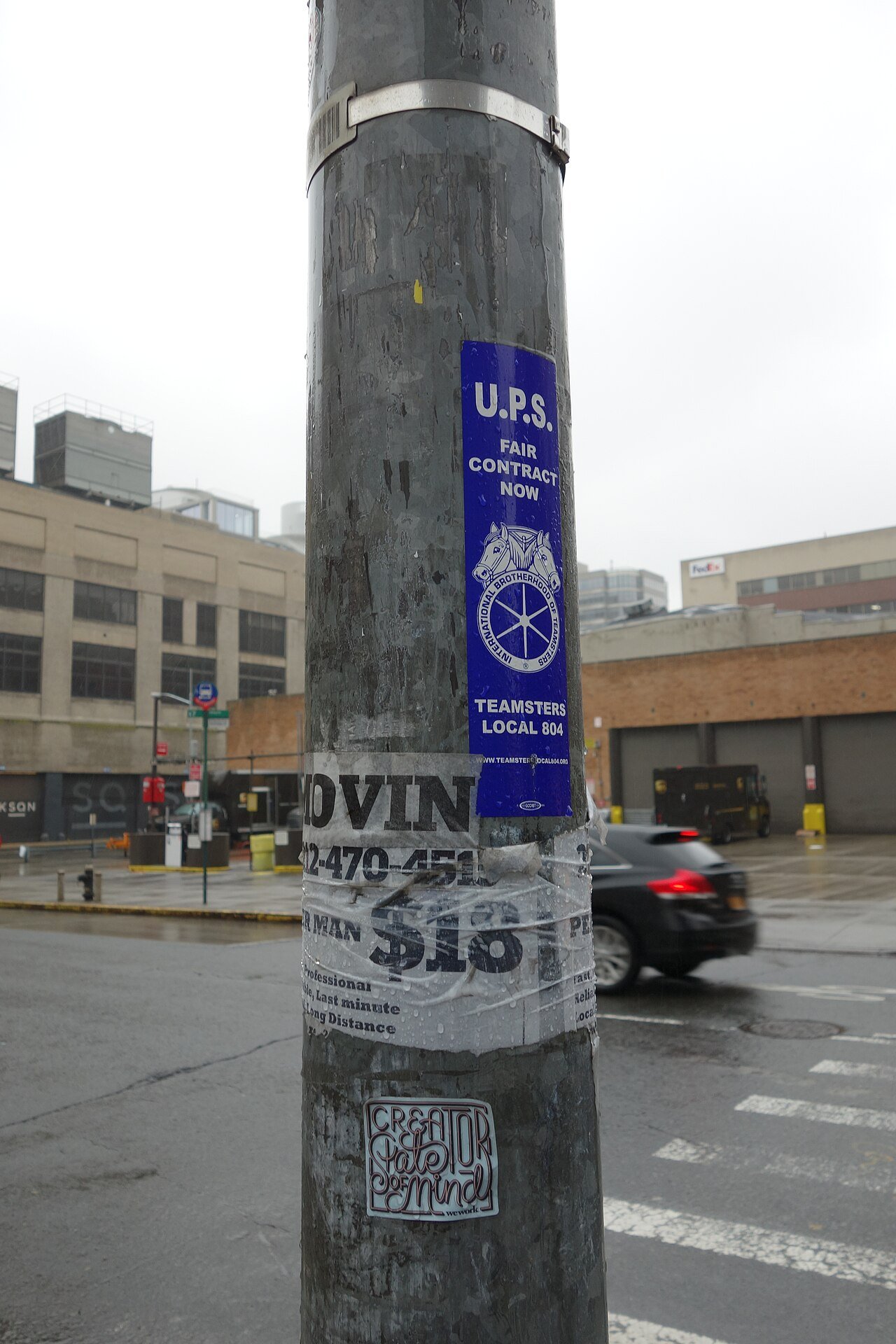

Nothing in the bill requires a move. UPS already delivers all over New York with drivers on its own payroll, Teamsters whose contract takes them to an average top rate of $49 an hour. Leaving would be Amazon’s choice, and so would the $5.
What happens next
The bill has 35 co-sponsors on the 51-member Council, and Mayor Zohran Mamdani backs it. Whether it gets a vote is up to Council Speaker Julie Menin, who called the campaign “deceptive” and said:
“It defies logic that Amazon, a $3 trillion corporation, would raise New Yorkers’ cost of living if it’s forced to adhere to basic regulations and worker protections.”
In October Menin said she had concerns about the bill as written and that the city’s Law Department was reviewing it. Its sponsor, Council Member Tiffany Cabán, told amNY: “It’s simply dishonest to claim that this bill would require them to charge consumers $5 for every delivery.”
The Council can set a license fee and a hiring rule. It cannot set the price of an Amazon order. Amazon is the one telling New Yorkers what that price will be.
Further Reading
- Amazon urges NYC customers to oppose delivery bill, CNBC on the pop-ups, the form and the 20,000 emails.
- Amazon Bankrolled $5M Campaign Against NYC Delivery Bill, New York Focus on the lobbying disclosures behind “New York Delivers” and the AKRF study.
- Barchart’s analysis of the AKRF figures, by Caleb Naysmith, on what the $5.20, 267% and $664 numbers cover.
- New York’s delivery bill would force Amazon, FedEx to run like UPS, The Conveyor on the bill’s terms.
- Amazon overtakes the Postal Service in parcel volume, Supply Chain Dive on ShipMatrix’s 2025 rankings.