
OpenAI said it banned a likely China-origin influence operation in June 2026 that posed as Americans on X and used AI-generated posts to argue that data centers push up household electricity bills. The operation attached its messaging to real reporting about power prices and growing demand, but OpenAI found no evidence that it meaningfully reached beyond its own network or shifted public opinion.
The campaign was an attempt to exploit a real domestic fight, not evidence that Beijing invented, or materially drove, America’s data-center backlash. A national survey conducted from June 16 to July 19 found that 61% of Americans opposed new data centers in their area, up from 49% in March, before Axios reported a separate X account cluster in late August.
The Data Center Bandwagon campaign used fake American personas
OpenAI called the operation “Data Center Bandwagon”. Its operators used ChatGPT through virtual private networks, or VPNs, to get around OpenAI’s regional access restrictions, then requested English-language posts, images and comic strips while presenting themselves as Americans from different backgrounds.
They made a simple pitch: large AI data centers use huge amounts of electricity; utilities and grid operators need more capacity; ordinary households end up paying. The accounts posted the material on X with links to legitimate news stories about the PJM grid operator’s capacity auctions and data-center demand.
That is not an invented concern. The campaign’s trick was to take a dispute Americans were already having and make its authors look like local people speaking spontaneously.
“The operation sought to exploit and amplify existing public concerns about energy prices and local impacts of data center development,” OpenAI wrote in its June 10 threat report.
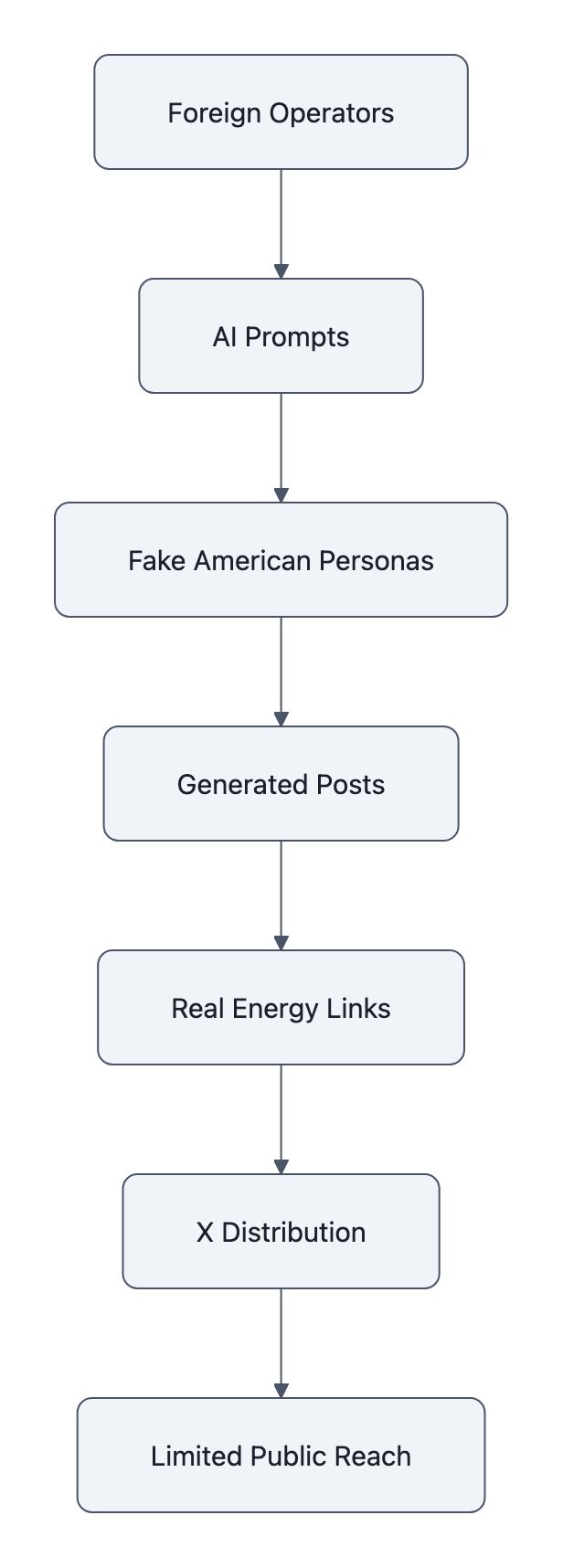
OpenAI said the accounts prompted its model in Simplified Chinese, asked for both Chinese and English output, and generated material aimed at two audiences: Americans debating AI infrastructure and overseas Chinese readers. In the U.S.-focused content, the operators asked for edited images and cartoons depicting households subsidizing well-connected data-center owners.
The company’s assessment of who did this is narrower than the phrase “Chinese psyop” suggests. OpenAI assessed that the operators likely came from a social-media team at a private Chinese technology company working for provincial-level government clients. It said the activity fit a commercial ecosystem that supports Party-state priorities in public-opinion work.
That is not proof that China’s central government ordered the campaign. OpenAI’s attribution is probabilistic, and its public account is the primary evidence for the ChatGPT-linked cluster. The report also does not provide a count of accounts, impressions, views or engagement.
OpenAI did disrupt accounts that used its product, but it has its own stake in this argument. In January, OpenAI and SoftBank said they were each investing $500 million in SB Energy, while OpenAI signed a lease for a 1.2-gigawatt data-center site in Milam County, Texas. That commercial interest does not invalidate its findings. It does mean that a narrative turning local resistance into foreign manipulation happens to be convenient for a company trying to build very large facilities.
The same local concerns have already surfaced in fights over land use, water, emissions and electricity costs, including the local political backlash to data-center development and the transparency fight over data-center environmental impacts.
Local opposition rose to 61% before Axios reported X’s separate account cluster
The independent evidence points to a backlash with plenty of domestic fuel. The Annenberg Public Policy Center surveyed 1,320 U.S. adult citizens and found 61% somewhat or strongly opposed new nearby data centers. Opposition crossed party lines: 69% of Democrats, 54% of Republicans and 53% of independents opposed local construction.

The shift was unusually concentrated. Views on AI’s overall effects and public demand for AI regulation stayed broadly stable from spring, while nearby data centers became sharply less popular. That is a specific objection to the physical infrastructure, substations, transmission lines, noise, water use and power demand, not a general wave of anti-AI sentiment.
There is also a concrete electricity-market dispute beneath the slogans. PJM’s independent market monitor concluded that existing and forecast data-center load, along with market-design flaws, primarily drove higher clearing prices in its 2025/2026 capacity auction. A capacity auction is the mechanism grid operators use to pay generators for being available when demand peaks.
The monitor found that PJM’s demand-curve design added $7 billion to capacity payments, a 91.3% increase compared with a vertical reliability-based demand curve. That analysis does not isolate one universal household-bill increase caused solely by data centers: it explicitly identifies both large-load demand and flawed market design.
PJM itself forecast that data-center growth could add up to roughly 30 gigawatts of demand between 2025 and 2030. For scale, that is new consumption equivalent to the output of dozens of large power plants, arriving in one regional grid footprint. Ratepayer anxiety does not require a foreign bot farm to become politically potent.
Axios reported on August 28 that X had identified roughly 200 accounts posting in ways that could manipulate the AI-and-energy debate, within a suspected 200,000-account network. But X publicly supplied no methodology, reach data, demonstrated policy effect or proven link between those accounts and OpenAI’s June cluster.
Jim Prosser, a Silicon Valley communications consultant and former Twitter head of corporate communications, told Axios he found the “Chinese psyop” framing “worrying and frustrating.” He argued that it could become a messaging tool for large technology companies trying to redirect the data-center conversation.
That criticism is not a denial that foreign operators tried to interfere. They apparently did. It is a warning against treating every complaint about electricity bills or a proposed facility as suspect because some fake accounts repeated it.
The more revealing fact is that the Federal Energy Regulatory Commission has ordered all six regional grid operators to justify or reform rules for connecting data centers and other large electricity users. The argument over who pays for AI’s power appetite is now embedded in U.S. grid policy. Bots can decorate that dispute; they did not build it.
China remains central to Washington’s AI competition debate, but calling local opposition a foreign operation is a useful shortcut for anyone who would rather not answer the bill.
Key Takeaways
- OpenAI banned a likely China-origin cluster that used AI-generated posts and fake American personas to criticize U.S. data-center development.
- OpenAI found no evidence that the Data Center Bandwagon campaign meaningfully broke out or changed U.S. public opinion.
- OpenAI assessed that the operators likely worked for a private Chinese technology company serving provincial-level government clients.
- A June-to-July 2026 national survey found 61% of Americans opposed new data centers in their communities, up from 49% in March.
- PJM’s independent market monitor linked higher capacity-auction prices to both large data-center load and market-design flaws.
Further Reading
- “Data Center Bandwagon” Campaign: US-targeted influence activity, OpenAI’s case study of the alleged operation’s personas, prompts, images and distribution.
- PRC-linked influence operations are targeting AI debates in the US, OpenAI’s June 2026 threat report, including its finding of no meaningful breakout.
- China is secretly fueling America’s data center rage, Axios’s report on X’s separate suspected account network.
- Opposition to Local Data Centers Rises Sharply, Annenberg’s nationally representative survey of U.S. public opinion.
- Analysis of the 2025/2026 RPM Base Residual Auction Part H, PJM’s independent market monitor’s analysis of capacity prices and large-load demand.